

ग्रेटर नोएडा में पति-पत्नी और 3 बच्चों की
Oct 17, 2026






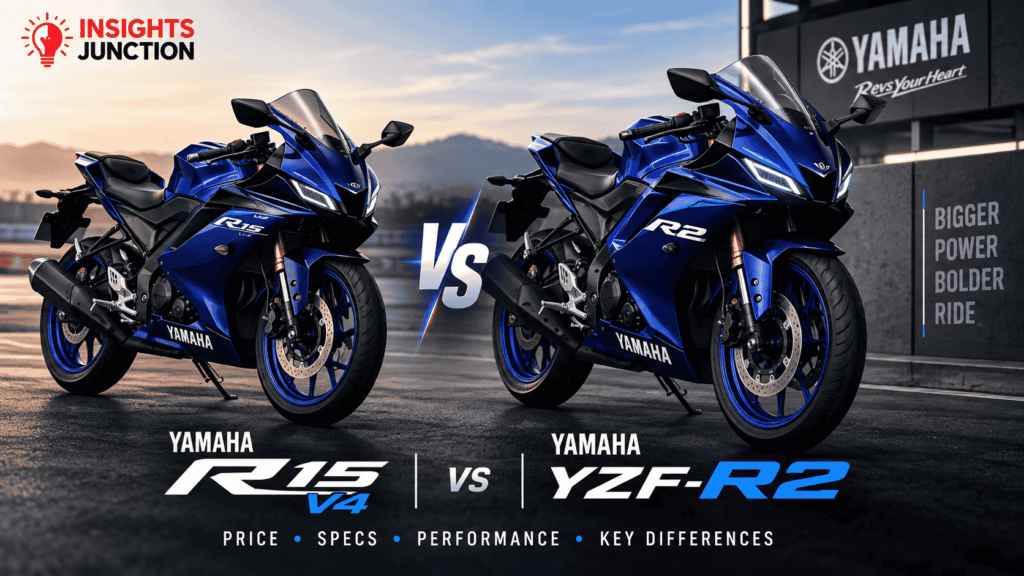


























































Yamaha R2 vs KTM RC 200: Price, Specs & Features Compared

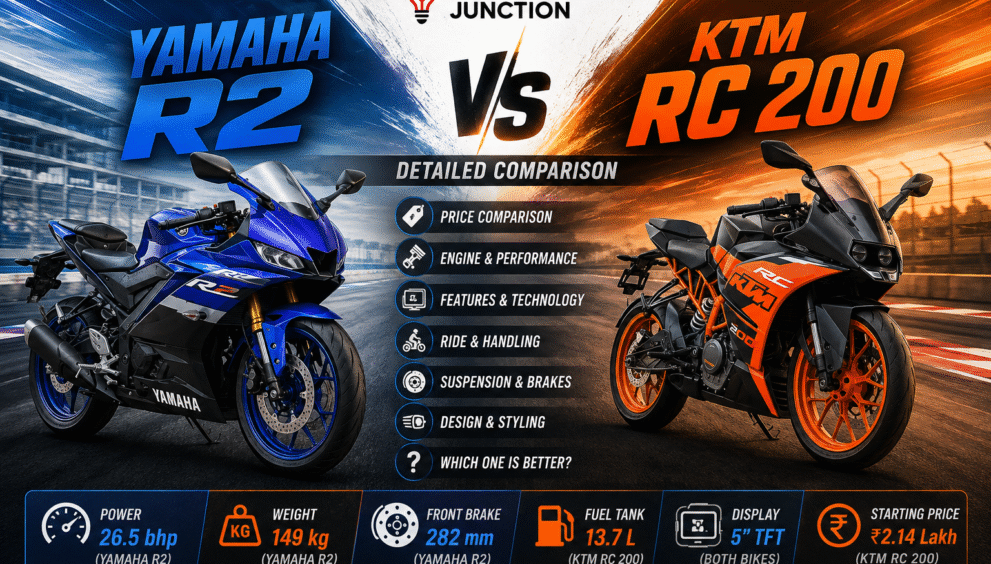
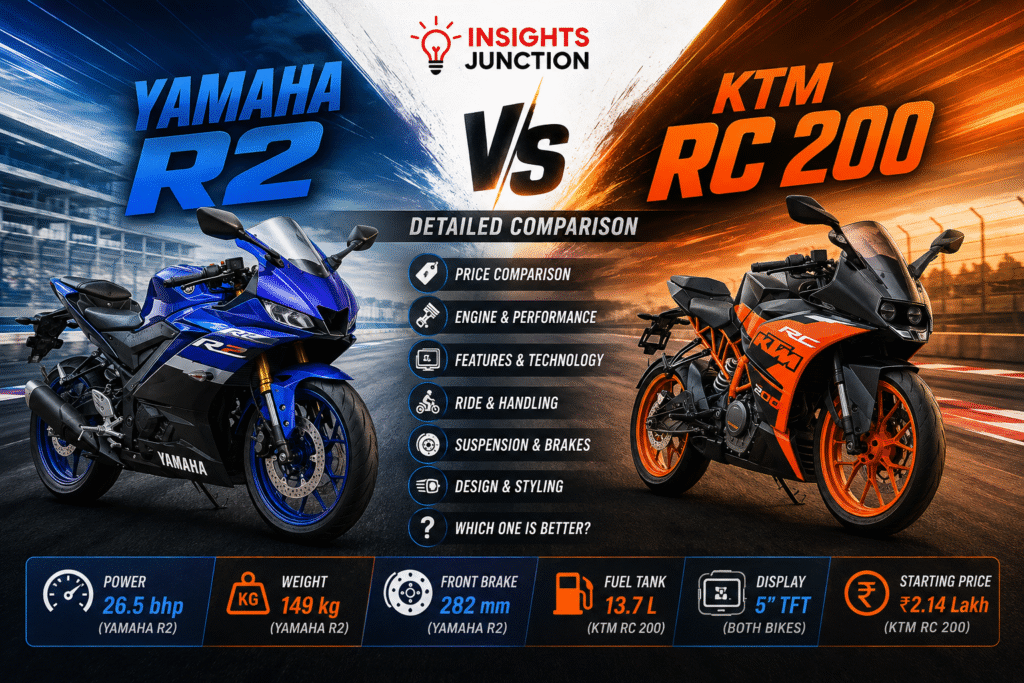
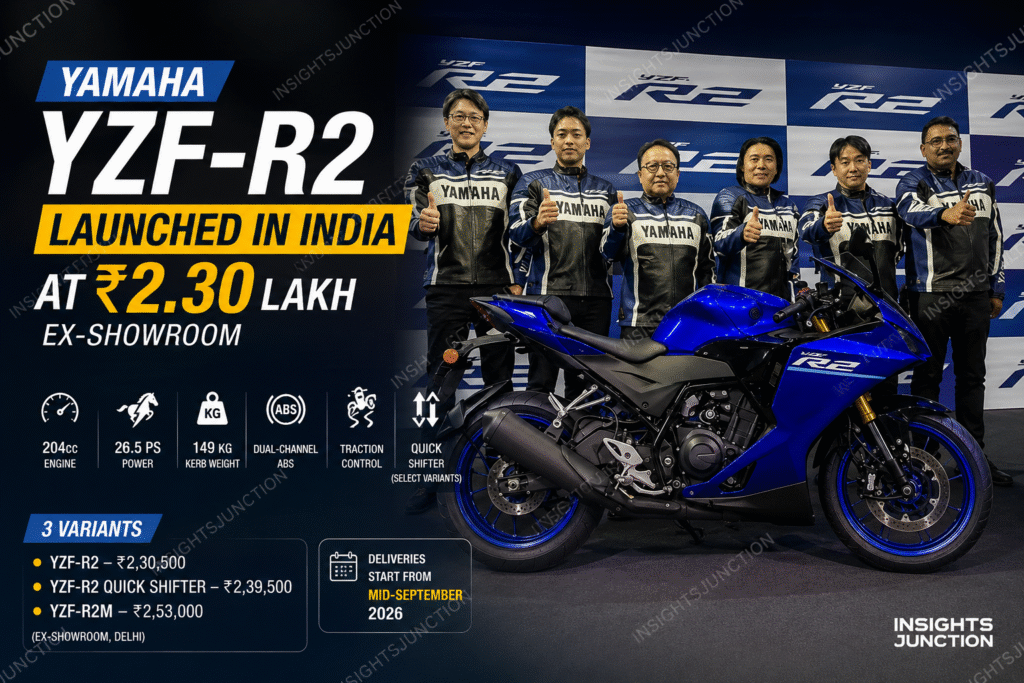
The Indian 200cc sports-bike segment has become more interesting with the arrival of the new Yamaha YZF-R2. Yamaha has launched the R2 in India as its first motorcycle in the 200cc supersport category, putting it directly against established models such as the KTM RC 200.
On paper, both motorcycles offer a similar formula: a liquid-cooled single-cylinder engine, aggressive fully-faired styling, six-speed gearbox and sporty chassis. However, their approach is quite different.
The Yamaha R2 focuses strongly on low weight, power-to-weight ratio, rider aids and modern technology, while the KTM RC 200 continues to offer larger suspension components, wider tyres and bigger brake discs.
So, Yamaha R2 vs KTM RC 200 — which one is better? Let’s compare their price, engine, performance, dimensions, suspension, brakes, features and overall value.
Yamaha R2 vs KTM RC 200: Price Comparison
The Yamaha YZF-R2 is available in three variants in India, while the KTM RC 200 is currently offered as a single model.
| Bike | Variant | Ex-Showroom Delhi |
| Yamaha R2 | Standard | ₹2,30,500 |
| Yamaha R2 | Quick Shifter | ₹2,39,500 |
| Yamaha R2 | R2M | ₹2,53,000 |
| KTM RC 200 | RC 200 | ₹2,14,721* |
*KTM India’s current official website lists the RC 200 at ₹2,14,721 ex-showroom Delhi. Recent comparison reports published around the R2 launch used an earlier RC 200 price of about ₹2.32 lakh.
This makes the current KTM RC 200 noticeably cheaper than the Yamaha R2 base variant.
However, price alone does not tell the complete story. The Yamaha offers more variants and a larger electronics package, while the KTM brings stronger hardware in some key areas.
Yamaha R2 vs KTM RC 200: Engine & Performance
This is one of the closest areas of the comparison.
The Yamaha R2 gets a newly developed 204cc, liquid-cooled, DOHC, four-valve, single-cylinder engine. Yamaha claims 26.5 PS and 19.1 Nm.
The KTM RC 200 uses a 199.5cc, liquid-cooled, DOHC, single-cylinder engine producing 25 PS and 19.2 Nm.
| Specification | Yamaha R2 | KTM RC 200 |
| Engine | 204cc | 199.5cc |
| Engine type | Single-cylinder, liquid-cooled | Single-cylinder, liquid-cooled |
| Maximum Power | 26.5 PS | 25 PS |
| Peak Torque | 19.1 Nm | 19.2 Nm |
| Gearbox | 6-speed | 6-speed |
| Fuel System | Fuel Injection | Fuel Injection |
The Yamaha has a 1.5 PS power advantage, while the KTM has a marginal 0.1 Nm torque advantage.
Both produce their peak figures around similar engine speeds. Autocar’s comparison also highlights the Yamaha’s stronger power-to-weight ratio because of its substantially lower kerb weight.
Winner for engine output: Yamaha R2
On paper, the Yamaha R2 has the advantage in outright power.
Yamaha R2 vs KTM RC 200: Weight
This is where the Yamaha R2 makes a significant difference.
The Yamaha R2 base variant weighs just 149 kg, while the mid and top variants weigh 150 kg. The KTM RC 200 has a kerb weight of around 160 kg.
| Bike | Kerb Weight |
| Yamaha R2 | 149 kg |
| KTM RC 200 | 160 kg |
That means the base Yamaha R2 is approximately 11 kg lighter than the KTM.
For a sports motorcycle, lower weight can help with acceleration, direction changes, braking and everyday manoeuvrability.
This lightweight construction is one of the biggest advantages of the R2.
Winner for weight: Yamaha R2
If your priority is a lightweight and agile sports bike, the R2 has a clear advantage.
Yamaha R2 vs KTM RC 200: Power-to-Weight Ratio
The Yamaha’s weight advantage becomes even more important when combined with its higher power output.
According to Autocar India’s comparison, the R2 has a power-to-weight ratio of approximately 176.76 hp/tonne, compared with around 156.25 hp/tonne for the RC 200.
This gives the Yamaha a theoretical advantage in performance.
It does not automatically mean the R2 will be faster in every real-world situation, because acceleration also depends on gearing, tyres, aerodynamics and rider inputs. However, the numbers clearly favour the Yamaha.
Yamaha R2 vs KTM RC 200: Suspension
This is an area where the KTM fights back.
The Yamaha R2 gets a 37mm USD front fork and a linked monoshock. The KTM RC 200 uses a larger 43mm WP Apex USD fork and a WP Apex rear monoshock.
| Suspension | Yamaha R2 | KTM RC 200 |
| Front | 37mm USD fork | 43mm WP Apex USD fork |
| Rear | Linked monoshock | WP Apex monoshock |
| Adjustability | Front/rear on R2M | Rear preload |
The KTM’s larger 43mm fork gives it a hardware advantage, particularly for riders who prioritise aggressive riding and track-oriented hardware.
The Yamaha R2M, however, gets adjustable front and rear suspension, giving the top variant more scope for setup changes.
Winner for suspension hardware: KTM RC 200
Yamaha R2 vs KTM RC 200: Brakes
The KTM also has the advantage when it comes to brake hardware.
The Yamaha R2 gets a 282mm front disc and 220mm rear disc, while the RC 200 uses a much larger 320mm front disc and 230mm rear disc. Both motorcycles offer dual-channel ABS.
| Brakes | Yamaha R2 | KTM RC 200 |
| Front Disc | 282mm | 320mm |
| Rear Disc | 220mm | 230mm |
| ABS | Dual-channel | Dual-channel |
| Front Fork | 37mm USD | 43mm WP Apex USD |
The KTM’s larger discs and larger fork give it a more substantial hardware package.
Winner for brake hardware: KTM RC 200
Yamaha R2 vs KTM RC 200: Tyres
The KTM RC 200 also gets wider tyres.
Yamaha R2:
- Front: 100/80-17
- Rear: 140/70-17
KTM RC 200:
- Front: 110/70-17
- Rear: 150/60-17
The wider tyres on the KTM can offer additional grip and a more planted feel, particularly during aggressive cornering.
Winner for tyre hardware: KTM RC 200
Yamaha R2 vs KTM RC 200: Features
This is arguably where the Yamaha R2 has its biggest advantage.
The R2 comes with a 5-inch full-colour TFT display, smartphone connectivity, traction control and Yamaha Ride Control with three riding modes: Rain, Street and Sport.
The KTM RC 200 also gets a 5-inch display and smartphone connectivity, along with Supermoto ABS mode, which allows the rider to disable rear ABS intervention. It also gets a quickshifter according to BikeWale’s comparison.
Yamaha R2 feature highlights
- 5-inch full-colour TFT
- Smartphone connectivity
- Traction Control System
- Street mode
- Sport mode
- Rain mode
- Assist & Slipper Clutch
- Bi-directional Quick Shifter on selected variants
- Smart Key on R2M
- Adjustable suspension on R2M
- Adjustable clutch and brake levers on R2M
KTM RC 200 feature highlights
- 5-inch display
- Smartphone connectivity
- Supermoto ABS
- Quickshifter
- Dual-channel ABS
- Ride-focused electronics
- Adjustable rear suspension
The Yamaha offers a broader electronic package, especially on the R2M.
Winner for features: Yamaha R2
Yamaha R2 vs KTM RC 200: Design
Both bikes are designed around a proper supersport theme, but their styling philosophies are different.
The Yamaha R2 follows the latest R-Series design language and takes inspiration from larger Yamaha R-Series motorcycles. Its sharp fairing, compact front end and raised rear section give it a modern big-bike appearance.
The KTM RC 200 follows KTM’s distinctive RC family styling and draws inspiration from the larger RC models.
The choice here is subjective, but the newer R2 has an advantage in terms of freshness because the RC 200’s current design has been on the market for longer.
Design winner: Yamaha R2
Yamaha R2 vs KTM RC 200: Dimensions
Here is how the two motorcycles compare:
| Dimension | Yamaha R2 | KTM RC 200 |
| Fuel Tank | 12 litres | 13.7 litres |
| Ground Clearance | 170mm | Around 158mm |
| Seat Height | 810mm | 835mm |
| Kerb Weight | 149kg | 160kg |
| Wheel Size | 17-inch | 17-inch |
The Yamaha has a lower seat height and higher ground clearance, while the KTM has the larger fuel tank.
The KTM’s 13.7-litre tank gives it an advantage for riders who value longer distances between fuel stops.
Yamaha R2 vs KTM RC 200: Which Is Better for Daily Riding?
For daily riding, the Yamaha R2’s lower weight and lower seat height could make it easier to manage in traffic.
The R2 also gets Rain mode and traction control, which can be useful for varying road conditions.
The KTM RC 200, on the other hand, has a larger fuel tank and an adjustable handlebar setup that can allow riders to choose between a more relaxed street position and a more committed riding position. KTM also highlights its redesigned seats and rider-focused ergonomics.
For urban use, the Yamaha’s lighter weight could be particularly appealing.
Daily-use advantage: Yamaha R2
Yamaha R2 vs KTM RC 200: Which Is Better for Performance Riding?
This depends on what type of performance you value.
If you want higher power, lower weight and a stronger power-to-weight ratio, the Yamaha R2 looks more attractive on paper.
If you want larger brakes, wider tyres and larger WP Apex suspension hardware, the KTM RC 200 has a strong case.
The KTM’s chassis and braking hardware are more substantial, while the Yamaha counters with its low weight and higher engine output.
Performance verdict: Depends on riding style
Yamaha R2: Better power-to-weight and lighter chassis
KTM RC 200: Stronger suspension, tyre and brake hardware
Yamaha R2 vs KTM RC 200: Quick Comparison
| Category | Winner |
| Price | KTM RC 200* |
| Engine Power | Yamaha R2 |
| Torque | KTM RC 200 |
| Kerb Weight | Yamaha R2 |
| Power-to-Weight | Yamaha R2 |
| Suspension Hardware | KTM RC 200 |
| Brake Hardware | KTM RC 200 |
| Tyre Size | KTM RC 200 |
| Electronics | Yamaha R2 |
| Riding Modes | Yamaha R2 |
| Quick Shifter | Tie / variant-dependent |
| Fuel Tank | KTM RC 200 |
| Seat Height | Yamaha R2 |
| Ground Clearance | Yamaha R2 |
| Design | Subjective, but R2 feels newer |
| Overall Value | Depends on buyer priorities |
*Based on current KTM India official pricing.
Yamaha R2 vs KTM RC 200: Complete Specifications Comparison
| Specification | KTM RC 200 | Yamaha R2 |
| Engine Type | Single-cylinder, liquid-cooled, DOHC, FI | Single-cylinder, liquid-cooled, DOHC, 4-valve |
| Engine Displacement | 199.5 cc | 204 cc |
| Maximum Power | 25 PS @ 10,000 rpm | 26.5 PS @ 10,000 rpm |
| Peak Torque | 19.2 Nm @ 8,000 rpm | 19.1 Nm @ 8,000 rpm |
| Transmission | 6-speed | 6-speed |
| Bore × Stroke | 72 × 49 mm | 66 × 59.6 mm |
| Compression Ratio | 13.3:1 | 11.5:1 |
| Cooling System | Liquid-cooled | Liquid-cooled |
| Fuel System | Bosch EFI | Fuel Injection |
| Emission Standard | BS6 Phase 2B | BS6 Phase 2B |
| Kerb Weight | 160 kg | 149 kg (base) |
| Seat Height | 835 mm | 810 mm |
| Ground Clearance | 156–158 mm | 170 mm |
| Wheelbase | 1,341 mm | 1,340 mm |
| Fuel Tank Capacity | 13.7 litres | 12 litres |
| Front Tyre | 110/70-17 | 100/80-17 |
| Rear Tyre | 150/60-17 | 140/70-17 |
| Wheel Type | Alloy | Alloy |
| Tyre Type | Tubeless | Tubeless |
| Front Brake | 320 mm Disc | 282 mm Disc |
| Rear Brake | 230 mm Disc | 220 mm Disc |
| ABS | Dual-channel ABS | Dual-channel ABS |
| Front Suspension | 43 mm WP Apex USD Fork | 37 mm USD Fork |
| Rear Suspension | WP Apex Monoshock | Linked-type Monocross |
| Frame | Split-Trellis Tubular Frame | Steel Tube Diamond Frame |
| Riding Modes | No dedicated riding modes | Rain, Street, Sport |
| Traction Control | Yes | Yes |
| Quick Shifter | Yes | Yes, select variants |
| Clutch | Wet Multi-Disc | Assist & Slipper |
| Instrument Cluster | 5-inch TFT | 5-inch TFT |
| Smartphone Connectivity | Yes | Yes |
| Top Speed | 140 km/h* | Not officially claimed |
| Variants | 1 current model listing | 3 variants |
| Colours | 3 current official colours | 5 colours |
| Starting Price | ₹2,14,721* | ₹2,30,500 |
| Top Variant Price | — | ₹2,53,000 |
Yamaha R2 vs KTM RC 200: Which One Should You Buy?
The answer depends largely on what you expect from your motorcycle.
Choose the Yamaha R2 if:
- You want a lighter sports bike
- You prefer higher power output
- You want a strong power-to-weight ratio
- You want traction control
- You want multiple riding modes
- You prefer a lower seat height
- You want a modern TFT display
- You want the option of a bi-directional Quick Shifter
- You like Yamaha’s latest R-Series styling
The Yamaha R2’s biggest strengths are its 149kg weight, 26.5 PS engine and modern electronics package.
Choose the KTM RC 200 if:
- You want a lower purchase price at current official pricing
- You prefer larger brakes
- You want wider tyres
- You want a larger 43mm USD fork
- You prefer KTM’s aggressive riding character
- You want a larger 13.7-litre fuel tank
- You value the RC’s track-oriented hardware
The RC 200 remains an attractive option because its mechanical package continues to focus heavily on suspension, braking and sporty handling.
Yamaha R2 vs KTM RC 200: Final Verdict
The Yamaha R2 vs KTM RC 200 comparison is not a simple case of one motorcycle being better in every area.
The Yamaha R2 is the newer-generation proposition and brings a 204cc engine, 26.5 PS, 149kg kerb weight, traction control, three riding modes, TFT instrumentation and optional bi-directional Quick Shifter. Its biggest advantage is the combination of low weight, higher power and modern electronics.
The KTM RC 200 takes a different approach. It offers larger 43mm WP Apex forks, wider tyres, larger brake discs, a 13.7-litre fuel tank and a proven supersport package.
So, if your priority is lightweight performance and modern technology, the Yamaha R2 is the more attractive choice.
If you are more interested in hardware, braking components and KTM’s race-focused chassis setup, the RC 200 remains a strong contender.
Ultimately, both motorcycles target enthusiasts who want a proper fully-faired sports bike, but they offer different interpretations of what a modern 200cc performance motorcycle should be.
Frequently Asked Questions
1. Which is more powerful, Yamaha R2 or KTM RC 200?
The Yamaha R2 is more powerful. Its 204cc engine produces 26.5 PS, compared with 25 PS from the KTM RC 200.
2. Which is lighter, Yamaha R2 or KTM RC 200?
The Yamaha R2 is lighter. The base R2 weighs 149kg, while the KTM RC 200 weighs around 160kg.
3. Is Yamaha R2 cheaper than KTM RC 200?
Based on current manufacturer-listed Delhi pricing, the KTM RC 200 at ₹2,14,721 is cheaper than the Yamaha R2’s ₹2,30,500 starting price. However, some launch-period comparison reports listed the KTM at about ₹2.32 lakh before the current price update.
4. Which bike has better brakes, Yamaha R2 or KTM RC 200?
The KTM RC 200 has larger brake discs, with a 320mm front and 230mm rear setup, compared with the Yamaha R2’s 282mm front and 220mm rear discs.
5. Does Yamaha R2 have a Quick Shifter?
Yes. The bi-directional Quick Shifter is available on the mid-spec Yamaha R2 and standard on the top-spec R2M.
6. Which has a bigger fuel tank, Yamaha R2 or KTM RC 200?
The KTM RC 200 has the larger fuel tank at 13.7 litres, compared with 12 litres for the Yamaha R2.
7. Which is better for beginners, Yamaha R2 or KTM RC 200?
Both can suit riders moving into the performance-bike segment, but the Yamaha R2’s lower 810mm seat height and 149kg base kerb weight may make it easier for some riders to manage. Actual suitability depends on the rider’s height, experience and riding environment.
8. Which bike has more features, Yamaha R2 or KTM RC 200?
The Yamaha R2 offers the broader electronics package, including traction control, three riding modes, TFT display and Quick Shifter availability. The KTM counters with features such as Supermoto ABS and its race-oriented hardware package.