

Vivo V80 5G India Launch: Price, Specifications, Features,
Sep 25, 2026
























































How AI Is Changing The Future of Work

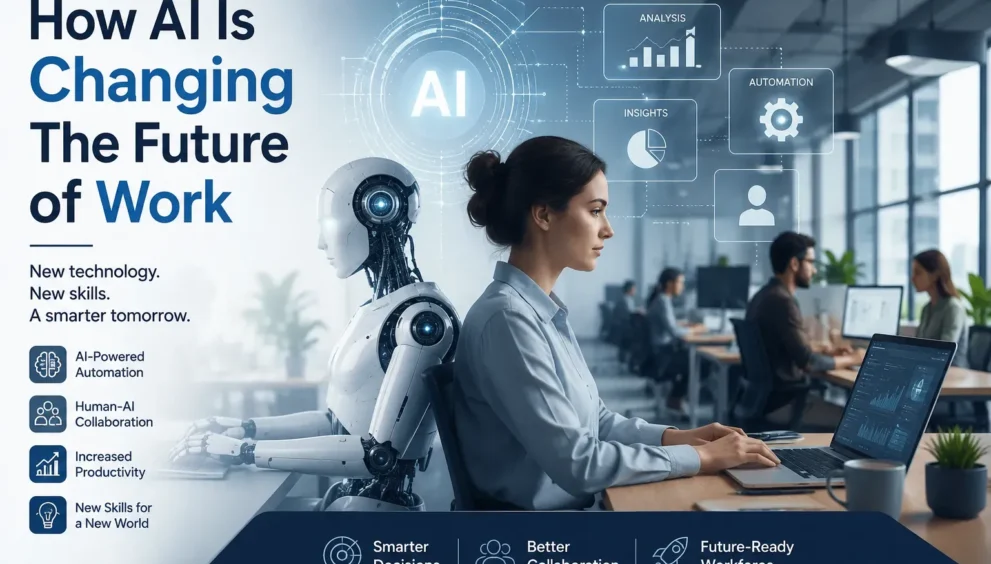
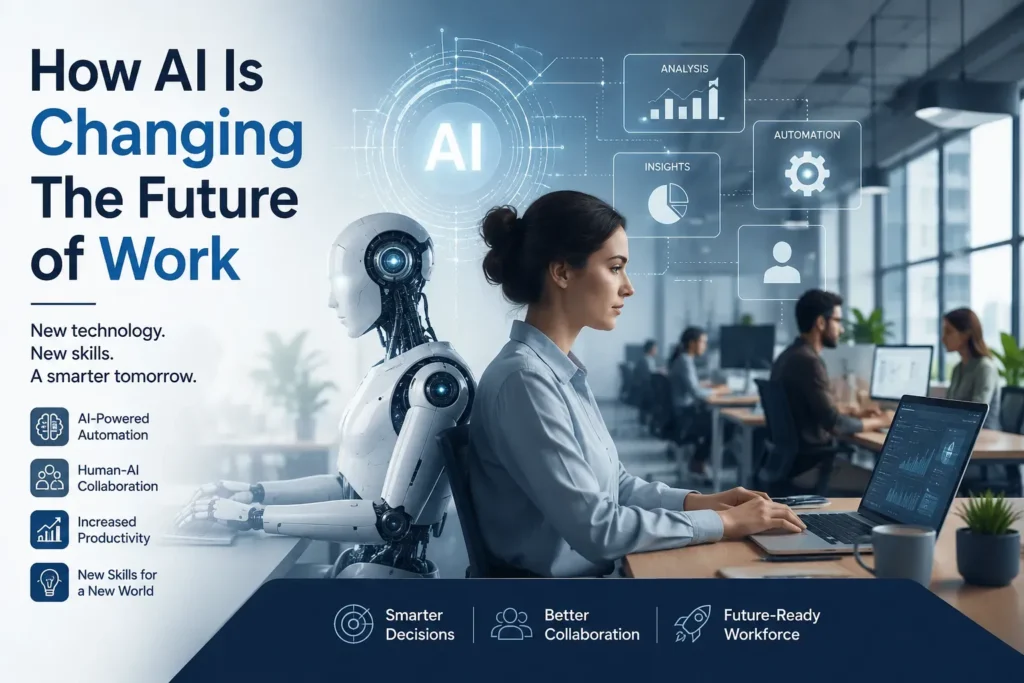
Artificial intelligence (AI) is no longer a futuristic concept—it is rapidly transforming the way businesses operate and how people work across industries. From automating repetitive tasks to enhancing decision-making and improving productivity, How AI is Changing The Future of Work has become one of the most important topics for professionals and organizations alike. Today, AI-powered tools are helping employees write content, analyze data, develop software, deliver customer support, and make smarter business decisions. As AI continues to evolve, the future of work will increasingly depend on human creativity, critical thinking, and the ability to collaborate effectively with intelligent technologies.
The Great Reshaping: What’s Actually Happening
The story of AI at work is not a simple one of robots stealing jobs. It is something more nuanced and, in many ways, more interesting: a fundamental reshaping of what work means and how it gets done.
McKinsey estimates that by 2030, up to 30% of hours currently worked globally could be automated. But history tells us that technological disruption and mass unemployment are not the same thing. The industrial revolution displaced weavers and created factory workers. The internet eliminated travel agents and created social media managers. AI will follow a similar pattern — destroying some roles, transforming many more, and creating categories of work we haven’t named yet.
What’s different this time is the speed and the scope. AI is not targeting a single industry or skill set. It’s touching knowledge work — the domain that was supposed to be automation-proof.
The Jobs Most Affected
Roles Being Redefined
Writing and Content Creation — AI tools can now generate first drafts, summarize documents, and produce marketing copy at scale. This doesn’t mean writers are obsolete. It means the valuable writer is one who brings judgment, voice, and original thinking — the things AI still does poorly.
Customer Support — Conversational AI handles a growing volume of routine queries, freeing human agents for complex, emotionally sensitive interactions. The support agent of the future is less a script-follower and more a skilled empathist.
Software Development — AI coding assistants like GitHub Copilot have become standard tools for professional developers. Studies suggest they can increase coding speed by 55% for routine tasks. The developer’s role is shifting from typing code to directing and reviewing AI-generated code.
Data Analysis — What once took an analyst a week — cleaning data, building dashboards, generating reports — can now be accomplished in hours with AI assistance. The premium shifts to asking better questions, not just running the numbers.
Roles Most Resilient
Some work remains stubbornly human. Jobs that require deep physical dexterity in unpredictable environments (plumbing, skilled trades), genuine emotional connection (therapy, nursing, teaching), creative originality, and complex ethical judgment are far more resistant to automation. At least for now.
The Rise of Human-AI Collaboration
The most important concept in the future of work is not replacement — it’s collaboration. The most effective workers going forward will be those who know how to work with AI, not those who compete against it.
This is already playing out in law firms, where AI handles discovery and contract review while lawyers focus on strategy. In hospitals, where AI flags potential diagnoses that doctors then evaluate with clinical nuance. In classrooms, where AI tutoring systems provide personalized practice while teachers focus on motivation, mentorship, and critical thinking.
The term for this is “augmented intelligence” — AI making humans more capable, not redundant. The surgeon who uses AI-guided imaging is more precise than one who doesn’t. The analyst with an AI assistant processes more data faster. The writer who uses AI for research can focus energy on the argument.
The skill gap opening up is not human vs. machine. It’s humans who can leverage AI vs. humans who can’t.
Also Read: How to Use AI For Content Creation
What Organizations Must Do Differently
For businesses, AI isn’t just a technology upgrade — it’s an organizational challenge.
Reskilling at scale. The World Economic Forum estimates that 50% of all employees will need significant reskilling by 2027. Companies that invest in this now will have a significant competitive advantage. Those that don’t will hemorrhage talent and relevance.
Redesigning workflows, not just adding tools. The companies getting the most from AI aren’t simply handing employees new software. They’re rethinking how work flows — which tasks belong to humans, which to AI, and where the handoffs happen.
Addressing trust and transparency. Employees need to understand how AI is being used in decisions that affect them — performance reviews, hiring, task allocation. Opacity breeds fear and resentment. Transparency builds trust and adoption.
Taking ethics seriously. AI systems carry the biases of the data they’re trained on. Organizations have a genuine responsibility to audit these systems for fairness, accuracy, and unintended consequences — especially in high-stakes domains like hiring, lending, and healthcare.
The Human Skills That Will Matter Most
If AI can handle information processing, pattern recognition, and routine task execution, what remains distinctly human? Quite a lot, as it turns out:
- Critical thinking — evaluating AI outputs, questioning assumptions, spotting errors
- Creativity — original ideas, novel connections, genuine innovation
- Emotional intelligence — empathy, leadership, conflict resolution, motivation
- Ethical judgment — navigating complexity, ambiguity, and values
- Communication — persuasion, storytelling, building genuine human connection
- Adaptability — learning continuously in a landscape that won’t stop changing
These aren’t soft skills. In the AI era, they are the hard skills that matter most.
A New Social Contract
The rise of AI at work raises questions that go beyond any individual company or career. If productivity surges but wages don’t follow, who benefits? If certain demographics are disproportionately displaced, what does society owe them? How do we ensure that the gains from AI are broadly shared?
These are political and philosophical questions as much as economic ones. The answers will require new policies around worker retraining, education, social safety nets, and potentially new frameworks for how we think about work, income, and value in human life.
The future of work is not a technology problem with a technology solution. It’s a human problem that technology is forcing us to confront.
Conclusion:
AI is not going to pause while we decide how to feel about it. The transformation of work is already happening — in every industry, at every level, on every continent.
Artificial intelligence is transforming the workplace faster than ever, changing how businesses operate and how professionals build their careers. While AI is automating repetitive tasks and improving efficiency, it is also creating new opportunities that require creativity, critical thinking, emotional intelligence, and adaptability. Rather than replacing human talent, AI is becoming a powerful tool that enhances productivity and supports better decision-making across industries. As technology continues to evolve, individuals who embrace continuous learning and develop AI-related skills will be better prepared for the future. Ultimately, How AI Is Changing The Future of Work is not just about technology—it’s about empowering people to work smarter, innovate faster, and thrive in an increasingly AI-driven world.