


Yamaha R15 V4 vs Yamaha YZF-R2
Sep 14, 2026




























































How to Keep Every Travel Document in One Place During International Trips

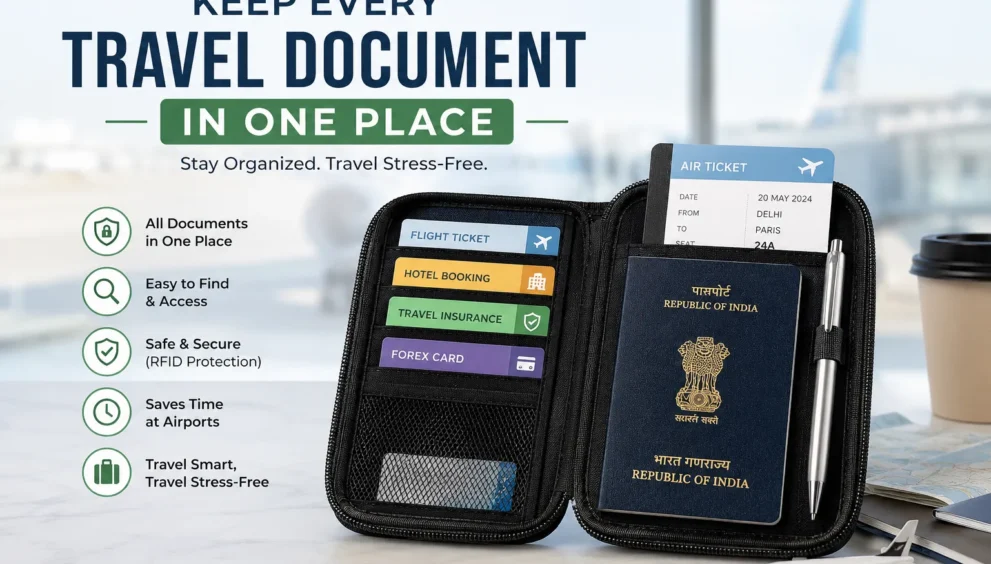
You know that moment at the airport when you’re patting every pocket and unzipping every compartment, and the boarding gate is about to close? That’s not bad luck. That’s a system problem.
Most Indian travellers pack beautifully. Clothes are sorted, chargers are remembered, snacks are packed. But documents? Those get stuffed wherever there’s space. And that’s the real problem.
International trips demand a lot of paperwork. Passports, visas, insurance, hotel bookings, forex cards, flight tickets – it adds up fast. And unlike your clothes, losing even one of these things mid-trip creates a serious, stressful situation that no amount of planning elsewhere can fix.
So let’s talk about how to actually get this right.
Why Most Travellers Struggle with Documents at Airports
It’s not about being disorganised by nature. Honestly, most people just don’t plan for how many times they’ll pull documents out and put them back during a single trip.
Think about it. You open your bag at check-in. Then at security. Then at the boarding gate. Then again, at immigration in the destination country. Then at the hotel front desk. That’s five separate moments where something can slip out, get handed back to the wrong pocket, or simply disappear into the chaos of your carry-on.
A survey by Amadeus found that close to 1 in 4 travellers experience significant anxiety around document management at airports. That stat isn’t surprising. It’s just honest.
The fix isn’t being more careful. It’s removing the possibility of making mistakes in the first place.
What You Actually Need to Carry for International Travel from India
Before you figure out how to organise everything, take stock of what “everything” actually means. For most Indians travelling abroad, here’s the real list:
Identity and entry documents:
- An Indian passport with at least 6 months of validity left
- Visa – printed copy of an e-visa, or stamped visa, depending on destination
- Return flight tickets, either printed or saved offline on your phone
- Travel insurance certificate
Money-related documents:
- Your forex card and the bank’s international helpline number
- Credit and debit card emergency numbers are written somewhere separate from the cards themselves
- A small amount of foreign currency in cash for your first few hours
Trip documents:
- Hotel booking confirmation with check-in details
- Airport transfer or cab booking references
- Any pre-booked experiences, tours, or restaurant reservations
Health documents (depends on destination):
- Vaccination records, if your destination requires them – yellow fever certificates are mandatory for several African and South American countries
- Health declaration forms are still required by the country at entry
That’s easily 10 to 15 physical items and as many digital references. Managing all of that across three different bags and two phones is how documents go missing.
The Only System That Actually Works: One Place, Every Time
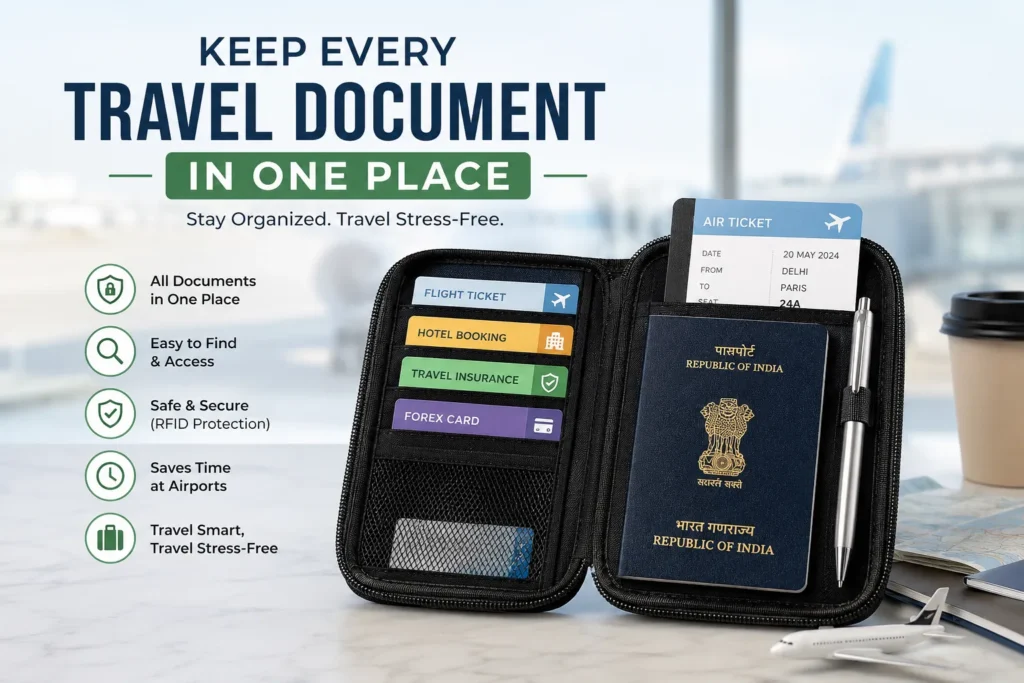
Here’s the straightforward answer – pick one dedicated travel wallet, use it for every trip, and make it the single home for every document you need. Not your jacket pocket. Not the side of your laptop bag. One wallet, consistently used.
This sounds obvious. But most people still don’t do it, and that’s exactly why airport stress happens.
What Should Your Travel Wallet Actually Have?
Not all travel wallets are built for international travel. A good one needs to fit your full Indian passport, hold a visa printout without folding it awkwardly, carry 4 to 6 cards, have a zipped section for loose items like SIM cards or cash, and ideally include RFID-blocking material.
It should also fit in your inner jacket pocket or the front pocket of your carry-on without being bulky. If you have to dig to find the wallet itself, you’ve already lost half the benefit.
RFID blocking matters more than most people think. Indian e-passports issued after 2021 carry biometric chips. Many bank cards are contactless. In crowded airports and tourist areas, RFID skimming is a documented form of digital theft. An RFID-blocking wallet adds zero inconvenience and meaningful protection.
The Exact Order to Arrange Your Documents
Put things in the order you’ll use them, not the order you packed them.
Passport and visa go in the front, most accessible slot. These are the first things immigration asks for. Flight tickets go right behind. Travel insurance and hotel confirmations go further back – you’ll need them, but not until you’re past the gates. Cards and cash fill the interior slots.
This one habit – ordering by use, not by random packing – means every document hand-off at the airport takes seconds instead of minutes.
Your Travel Kit and Why It Matters
Documents live in your travel wallet. Everything else – cables, adapters, earphones, medicine, power bank – lives in your travel kit.
Keeping these two things separate is what makes the whole system work. When someone at immigration asks for your passport, you don’t open your travel kit. You open your travel wallet. When your phone dies, and you need a charger, you don’t rifle through your document pouch. You go to your travel kit.
A practical travel kit for international trips from India typically needs:
- Universal travel adapter (India uses Type D plugs; most destinations don’t)
- Phone and laptop chargers, plus at least one USB-C cable
- Portable power bank
- Earphones
- Basic medication, clearly labelled and in original packaging
- A small notebook for PINs, emergency numbers, and addresses
- One or two spare passport-size photographs
That last one is genuinely useful. Visa-on-arrival desks in countries like the Maldives, some Southeast Asian destinations, and parts of the Middle East sometimes ask for photographs. Having two in your kit costs nothing and saves real trouble.
India’s customs rules, updated by the Central Board of Indirect Taxes and Customs, allow duty-free imports up to a certain value. If you shop abroad, a small printed note of current limits is worth keeping in your travel kit for the return journey.
Digital Backups: Are They Enough?
No. Digital backups are important, but they’re not a replacement for physical copies.
Scan everything before you leave – passport bio page, visa, tickets, insurance, hotel confirmation – and store copies on Google Drive, iCloud, or email them to yourself. This works as a backup when originals are lost or damaged.
But relying entirely on your phone screen is risky. Phones run out of battery. Airport Wi-Fi is unreliable. And immigration officers in countries like Vietnam, Thailand, and parts of the Gulf have historically asked for physical printouts even for e-visas.
The practical rule: carry one printed copy of every critical document, stored in a different section of your travel wallet from the originals. If something gets lost, you have a backup. If an officer wants a printout, you already have one.
How to Keep Documents Safe from Physical Damage
Documents don’t just get lost. They get ruined.
A leather or structured hard-shell travel wallet protects far better than a paper envelope or thin cloth pouch. If you’re travelling to Southeast Asia during monsoon season, or anywhere humid, this matters. Documents tucked into a back pocket or loose in a fabric bag pick up moisture, ink bleeds, and paper wrinkles.
A few habits that make a real difference:
- Keep your travel wallet in an inner bag pocket, not an outer one
- At the beach or pool, put your travel wallet in the hotel safe and carry only a basic card holder for the day
- Don’t set your wallet down on airport bathroom sinks or wet surfaces
These aren’t complicated habits. They’re just easy to overlook until something goes wrong.
One Small Detail Worth Considering
Six identical black wallets in a security tray look exactly the same. People pick up the wrong one. It’s a real thing that happens.
A personalised travel wallet – one with your name or initials on the front – is instantly identifiable. It’s not just about style. It’s about not spending twenty minutes at an airport security desk sorting out whose documents are whose.
Brands like The Black Box Co. make personalised leather travel wallets and document organisers built exactly for this kind of daily and travel use, if that’s something you’d find useful.
Final Thoughts
Getting your travel documents organised is genuinely one of the highest-return things you can do before an international trip. It costs almost no time to set up and eliminates one of the most stressful possible airport experiences.
One dedicated travel wallet. Documents arranged in the order you’ll use them. A separate travel kit for everything else. Printed backups of the critical stuff. RFID protection for your passport and cards.
Set this up once. Use it on every trip. You’ll stop thinking about your documents entirely, which means you can start thinking about the trip itself.
Also read: 21 Cheapest Country to Travel From India
Frequently Asked Questions
What is the best way to organise travel documents for an international trip?
One dedicated travel wallet, documents in the order you’ll need them. Passport at the front, then tickets, then hotel and insurance behind. Keep everything in one place and never move it between bags.
Do I need physical copies, or are digital backups enough?
Both. Digital backups save you if originals are lost. But physical copies still matter — plenty of immigration counters and hotels across Southeast Asia and the Middle East will ask for them in person.
Is RFID protection in a travel wallet actually necessary?
Worth having. Indian e-passports and most bank cards carry chips that can be scanned without contact. An RFID-blocking wallet is a simple one-time decision that removes a real, documented risk at busy airports and tourist spots.
How do I stop my travel documents from getting wet or damaged?
Use a structured leather travel wallet instead of a fabric pouch or paper envelope. Keep it in an inner pocket of your bag, and leave it in the hotel safe on beach or pool days. Simple habits, but they work.