

ग्रेटर नोएडा में पति-पत्नी और 3 बच्चों की
Oct 17, 2026


























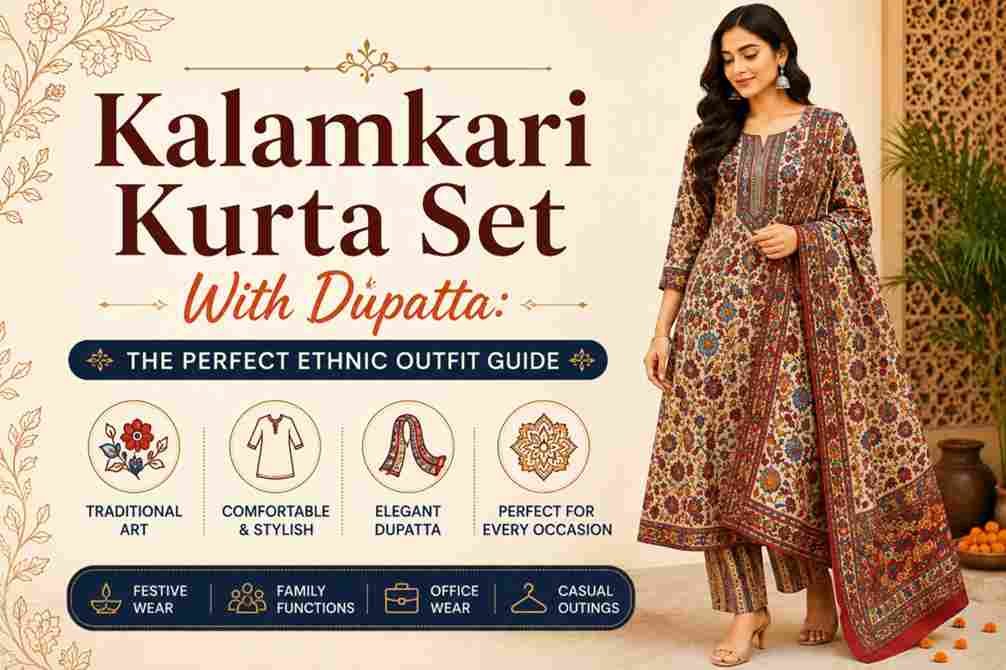







































Kalamkari Kurta Set With Dupatta: The Perfect Ethnic Outfit Guide

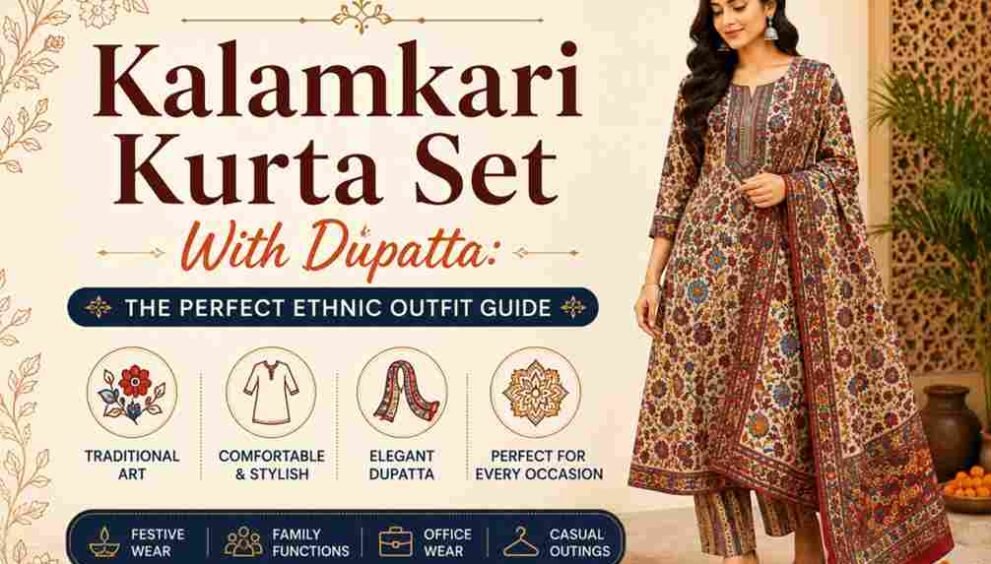
Honestly, the first time you hold a real kalamkari kurta in your hands, something feels different. The fabric has weight to it. The colours are not sharp and screaming like those synthetic printed sets you find stacked in every mall. They are quiet, earthy, and somehow familiar – like something you have seen on old temple walls or in your grandmother’s saree trunk.
Kalamkari has been around for over 3,000 years. That is not a marketing line. The craft originated in Andhra Pradesh and Telangana, and its name comes from two Persian words – kalam, meaning pen, and kari, meaning work. So quite literally, pen work. Every motif, every outline, every bird and lotus you see on that fabric was once drawn or stamped by hand.
Today, kalamkari kurta sets are everywhere – from high street ethnic stores to small artisan labels to big e-commerce platforms. But there is a massive gap between a genuine kalamkari piece and something that just looks like one. This guide will help you understand what you are looking at, how to wear it, and what actually matters when you go to buy one.
There Are Two Types of Kalamkari – And They Are Very Different
Most people do not realise this. They see the word kalamkari and assume it all comes from one place or one process. It does not.
The Geographical Indications Registry of India has granted separate GI tags to two distinct styles – the Srikalahasti style and the Machilipatnam style. Both are from Andhra Pradesh, but the process and the final result look quite different from each other.
Srikalahasti – The One Done Entirely by Hand
This is the older of the two traditions. Artisans use a hand-held bamboo pen dipped in natural dye to draw directly onto cotton fabric. The motifs are usually detailed mythological scenes – episodes from the Ramayana, Mahabharata, or stories of local deities. The outlines are done in a natural black ink made from iron scraps soaked in jaggery water for several days. No machine. No block. Just the artist’s hand and a kalam.
Because of the labour involved, genuine Srikalahasti kalamkari kurta sets tend to be more expensive. Each piece takes days to complete. And each one is slightly different from the last.
Machilipatnam – The Block-Printed Version
Machilipatnam kalamkari uses carved wooden blocks to stamp repeated patterns onto fabric. The designs are still intricate and the dyes are still often natural, but the process allows for consistent repeating patterns across larger fabric lengths. This is why most kalamkari kurta sets you find in the market, at mid-range price points, tend to be Machilipatnam style. The craft is still genuine – just different from the hand-painted version.
According to the Crafts Council of India, kalamkari supports over 100,000 artisan families across both these regions. Every piece you buy connects directly to that ecosystem, which is not something you can say about most machine-made ethnic wear.
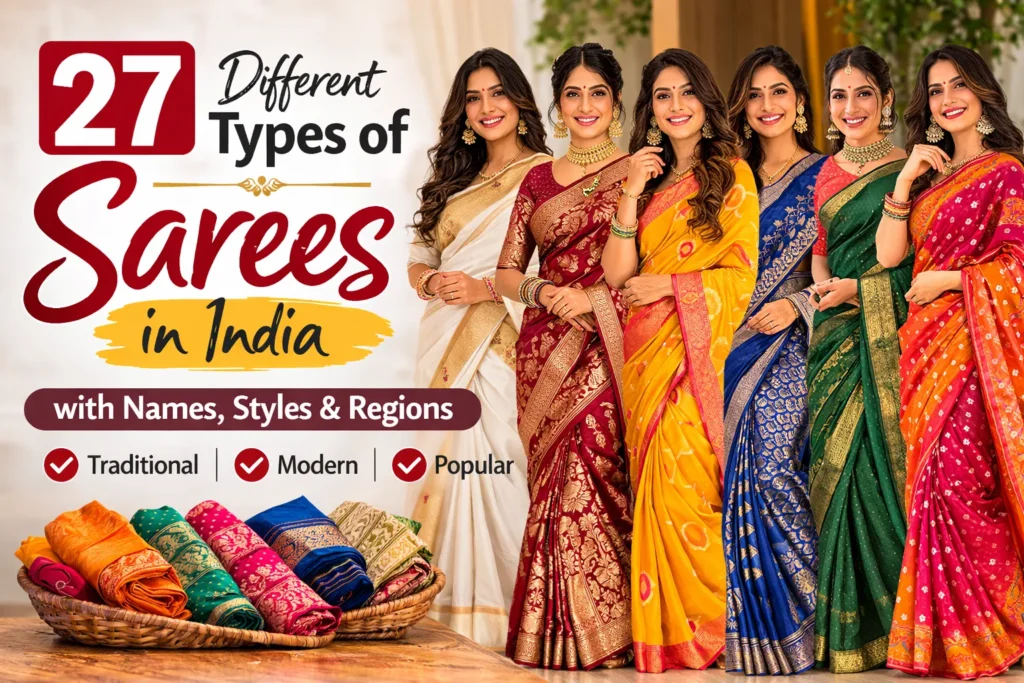
Read More: Different Types of Sarees
Which Fabric Actually Works Best for a Kalamkari Kurta Set?
This question matters more than most people think. The same kalamkari print on different fabrics does not look or feel the same at all.
Cotton is the traditional choice and still the best for daily wear. Natural dyes absorb beautifully into cotton. It breathes well in Indian summers, softens with every wash, and holds up over years if maintained properly. If you are buying your first kalamkari kurta set, start with cotton.
Chanderi Cotton has a subtle sheen that lifts the look without making it feel overdressed. A Chanderi kalamkari kurta set works well for family functions, evening events, or semi-formal occasions where plain cotton would feel too casual.
Silk kalamkari is in a different league altogether. The natural lustre of silk makes the motifs look richer and more layered. It is mainly used for premium kurta sets meant for weddings or significant occasions. Expect to spend more, but the drape is genuinely beautiful.
Linen has become popular in the last few years. It gives kalamkari a crisper, more structured look – less traditional, more contemporary. Works surprisingly well for workplaces that allow ethnic wear.
Georgette and crepe versions also exist, but they are further from the traditional form and often use printed designs rather than hand or block methods.
How to Wear a Kalamkari Kurta Set for Different Occasions
One thing kalamkari does very well is transition between settings. You do not need a separate outfit for every kind of day – the same set can be styled quite differently depending on what you pair it with.
Daily Wear and Office
Keep it simple. A straight-cut cotton kalamkari kurta with churidar or straight-leg pants in a complementary solid colour is clean and comfortable. Drape the dupatta loosely over one shoulder or leave it tucked in your bag for the commute. Small jhumkas and flat kolhapuri chappals are more than enough. The print does the work so you do not have to.
Festivals and Pooja Days
This is where kalamkari really shines. Go for richer tones – deep rust, ochre, indigo, forest green. An Anarkali-cut or A-line kalamkari kurta set is ideal here because the flare gives the large motifs room to show fully. Pair with gold-toned temple jewellery. The dupatta pinned to the shoulder with a small brooch looks intentional and put-together without being overdone.
Wedding Functions
Yes, you can absolutely wear a kalamkari kurta set to a wedding. A silk or Chanderi version with heavier motifs and an embroidered or zari-bordered dupatta reads as festive without competing with heavily embellished lehengas. Statement earrings, a simple potli bag, and heeled sandals handle the rest. This is actually a smarter choice than you might think – memorable, culturally grounded, and you will not run into someone wearing the same outfit.
Casual Outings and Everyday Errands
Short kalamkari kurtas with wide-leg pants or palazzos, the dupatta worn as a stole, and simple flats – that is it. The key here is to pick smaller, geometric or floral kalamkari prints rather than the large narrative scenes. Those work better when the silhouette gives them space.
What Do Kalamkari Motifs Actually Mean?
The patterns on a kalamkari kurta are not decorative filler. They come from a visual language that Indian craftspeople have been building for centuries.
Peacock (Mayura): The most recognisable kalamkari motif. It represents beauty, divine grace, and the natural world. Rarely a kalamkari piece exists without at least one peacock somewhere on it.
Lotus (Padma): A symbol of purity in both Hindu and Buddhist traditions. Used in borders, as central panels, or floating in the background of larger compositions.
Mango or Paisley: The teardrop mango shape is everywhere in Indian textiles. In kalamkari it usually appears in borders and all-over repeat patterns.
Elephants and horses: Often seen in processional scenes, especially in Srikalahasti work. Drawn with extraordinary detail – each animal individually rendered, never copy-pasted.
Mythological narratives: In hand-painted kalamkari, entire walls of the fabric tell stories. A single panel might depict a scene from the Ramayana with twenty characters, all individually worked. This is the art at its most ambitious.
When you understand what you are looking at, wearing the piece feels different. It is not just an outfit. It is a scene from a story.
How to Tell Real Kalamkari From a Printed Copy
This is probably the most practical section of this entire guide. With kalamkari becoming fashionable, the market is now full of machine-printed polyester or cotton fabric that uses kalamkari-style designs without any of the craft behind them. They look similar at first glance. They are not the same thing.
Here is what to check:
Look at both sides of the fabric: Genuine kalamkari with natural dyes will show colour on the reverse side too. Machine prints only exist on the surface.
Look for slight imperfections in the print: Real hand or block-printed kalamkari has small variations – a line slightly thicker here, a colour slightly deeper there. Perfect machine uniformity is actually the warning sign.
Ask about the dyes: Traditional kalamkari uses natural plant and mineral dyes – indigo, madder, pomegranate rind, iron-based black. If the seller cannot tell you anything about the dyes, that is a flag.
Check the GI tag for premium pieces: Authentic Srikalahasti or Machilipatnam kalamkari may come with GI-tagged certification from the Geographical Indications Registry of India. This is the clearest proof of origin.
Trust the price to some extent: A genuine hand-painted kalamkari kurta set cannot be very cheap. The labour alone is too intensive. If a price seems too low for what is claimed, it usually is.
Taking Care of Your Kalamkari Kurta – It Is Not Complicated
Natural dye fabrics need slightly different handling than synthetic ones. None of it is difficult, but if you ignore it, the colours will fade faster than they should.
Always cold wash for the first few washes: Natural dyes can bleed initially. Wash separately or with similar colours. Cold water keeps the dyes stable.
Use a mild detergent: Harsh chemicals strip natural dyes. A gentle, pH-neutral detergent works fine. Some people use reetha (soapnut) liquid with good results.
Dry in the shade: Direct sunlight bleaches natural dye fabrics over time. This is the single most important care habit for kalamkari.
Iron from the reverse side: Protects the print surface. Medium heat is sufficient for cotton.
That is genuinely all there is to it. A well-maintained kalamkari kurta set can last for many years and the colours actually develop a beautiful patina over time rather than just fading out.
Kalamkari and the Slow Fashion Conversation
There is a reason kalamkari keeps coming up whenever sustainable or conscious fashion is discussed in India. It fits the brief naturally, not because someone marketed it that way.
The traditional process uses natural dyes that are biodegradable. The fabric is typically unbleached or minimally processed natural cotton. The production is small-batch and handcraft-based, which means the environmental footprint at the artisan level is genuinely low. This is not a brand claim – it is just the nature of the craft.
India’s Ministry of Textiles has been working to support handloom and handicraft-based textiles through schemes under the National Handloom Development Programme and the India Handloom Brand initiative. The intent is to preserve crafts like kalamkari while connecting artisans to modern markets.
This shift is also visible in how Indian shoppers are buying. More people are asking where a piece comes from, who made it, and whether the craft behind it is genuine. Brands like The Jaipur Studio have grown in that space – not because they invented the conversation, but because they showed up on the right side of it.
The Kalamkari Colour Palette – Why It Looks the Way It Does
If you have ever noticed that kalamkari colours feel warm and slightly muted rather than sharp and bright, there is a direct reason for that. Every colour comes from nature.
Indigo blue comes from the indigo plant, one of the oldest documented natural dyes in Indian textile history.
Deep reds and rust come from alizarin, extracted from the roots of the madder plant.
Olive and forest greens are created by layering indigo with other dyes like pomegranate rind or turmeric.
Black is traditionally made from iron scraps dissolved in jaggery water and fermented over days. The outline work in kalamkari is almost always this natural black.
Yellow and ochre come from turmeric and pomegranate rind.
This earthy palette is one of the reasons kalamkari kurta sets are easy to style and comfortable to wear. These colours work on most Indian skin tones and pair naturally with gold-toned, oxidised silver, and terracotta jewellery.
To Wrap This Up
A kalamkari kurta set with dupatta is one of those purchases that quietly earns its place in your wardrobe over time. It is not trendy in a way that expires in one season. It is not costume-like in the way some heavily embroidered ethnic wear can feel. It just sits there looking like a real thing – because it is one.
The craft behind it is documented, geographically protected, and supported by generations of artisan knowledge that no machine has fully replicated. When you understand what went into making it, you wear it differently.
Whether you are new to kalamkari or looking to build a more thoughtful ethnic wardrobe, the basics stay the same – buy authentic clothing where you can, understand the motifs, pick fabric that fits your actual lifestyle, and take care of the piece properly. The rest takes care of itself.
Quick Answers to Common Questions:
Is a kalamkari kurta set only for formal occasions?
Not at all. A cotton kalamkari kurta with palazzos is one of the most comfortable things you can wear on a regular day out. It reads as ethnic without being heavy or overdressed.
How do I know if it is real kalamkari or just a printed copy?
Check the back of the fabric. Real kalamkari with natural dyes will show colour on both sides. Also look for small imperfections in the print – those are signs of hand or block work, not machine printing.
Can I wear a kalamkari set to a wedding?
Yes, especially a silk or Chanderi version with richer motifs. It is a thoughtful, culturally grounded choice that stands out in a good way without competing with bridal wear.
How long does kalamkari fabric last?
A well-cared-for kalamkari kurta can last several years easily. Cold wash, mild detergent, shade dry – that is the entire care routine. The colours may mellow slightly over time but that actually looks good.
What jewellery goes with kalamkari?
Oxidised silver, gold-toned temple jewellery, and terracotta pieces all work beautifully. The earthy tones of kalamkari clash with heavily bejewelled or very modern jewellery, so simpler is better here.


11 Comfortable Wedding Shoes for Modern Brides
09th Jun 2026[…] Kalamkari Kurta Set With Dupatta: The Perfect Ethnic […]