


ग्रेटर नोएडा में पति-पत्नी और 3 बच्चों की
Oct 17, 2026















































































What Are Logistics Planning Services and Why Do Businesses Need Them?


In modern business operations, logistics are a crucial function of a business to ensure efficient and timely delivery of goods, services, and resources. Businesses today operate in a competitive environment, using traditional supply chain management systems is no longer possible. Businesses need structured systems that can manage transportation, inventory, warehousing, and distribution of their products seamlessly and at the lowest cost.
Logistics planning services assist businesses to organize their supply chain activities, lower operational costs, and improve overall efficiency. Effective logistics planning can have a direct effect on customer satisfaction, and ultimately long-term growth, for any sized company.
As supply chains become increasingly more global and more complex, the importance of the Logistics Market is ever increasing. With this ever-increasing complexity of supply chains, more businesses are focusing on advanced logistics solutions that provide services to track products in real time, provide automation, and provide for data-driven decision making to remain competitive.
What Are Logistics Planning Services?
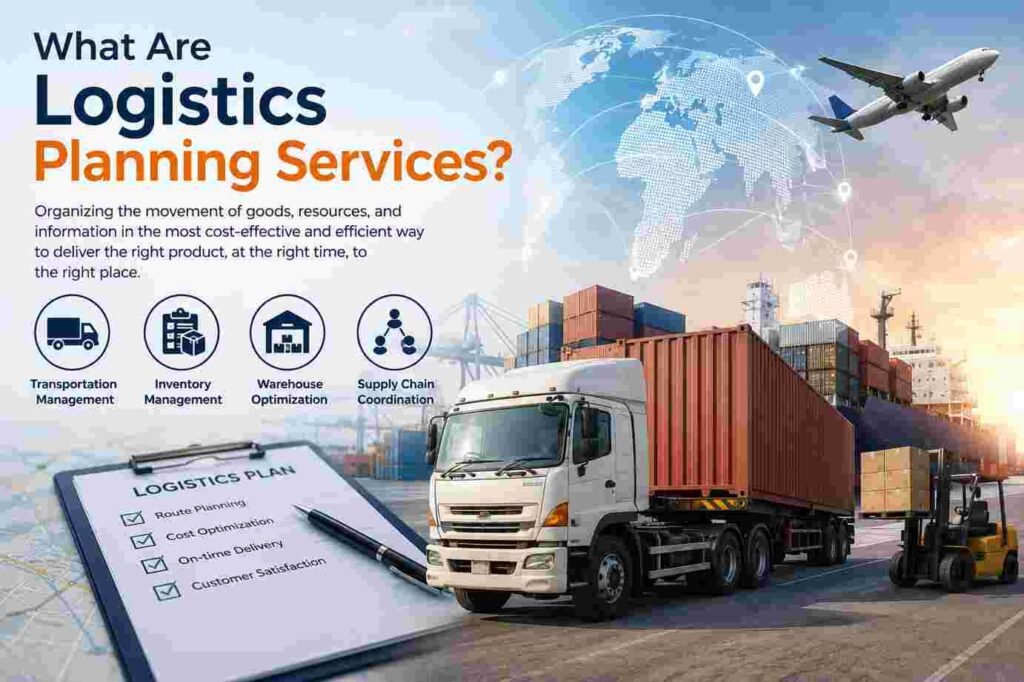
Logistic planning service is a service specifically focused on the organisation of goods, resources, and data movement from one point to another in the most cost-effective and efficient manner possible. Logistics service includes transportation, inventory management, warehouse and inventory optimisation, and supply chain coordination.
The purpose of logistic planning is to provide products to customers at the right time and location while maximising efficiency and minimising costs. Through using logistic planning services, companies can manage their resources more effectively and reduce any unnecessary costs associated with delays or inefficiencies.
In the majority of cases, companies will outsource these services to third-party logistics providers that have the technology, knowledge, and experience necessary to effectively and efficiently manage complex supply chains. This enables companies to concentrate on their core operations while also ensuring that logistics operations are executed efficiently and effectively behind the scenes.
Why Logistics Planning Is Important for Businesses
Proper logistics planning is a necessary part of any smooth running business. A strong logistics plan allows a company to avoid costly disruption to operations due to delays or increased transportation costs caused by poor planning and management of inventory and/or transportation.
By implementing logistics planning services, businesses can reduce costs through optimization of transportation routes, better use of warehouse space and timely delivery of goods. This enables a business to achieve higher profit margins and utilize their available resources more efficiently.
Improved customer satisfaction is another benefit of logistics planning. When goods are delivered on-time and in good condition, customers tend to be more trusting of the company and will likely continue to purchase from them. On-time delivery of goods can be the main competitive factor between companies in a given industry.
Logistics planning also provides businesses with better visibility throughout the entire supply chain. Businesses have the ability to track shipments, monitor inventory data and more accurately forecast demand. This improves decision making for a business and allows it to avoid supply chain complications.
Key Components of Logistics Planning and Management Services
Logistics planning and management services have many facets that connect and help to facilitate and operate a supply chain successfully. The main component of logistics planning and management is transportation management. Transportation management includes determining the best transportation method(s), route(s), and carriers to use, as well as establishing delivery frequency to achieve an efficient transportation system.
The second component is inventory management. Inventory management refers to how a company maintains the appropriate quantities of inventory for its daily operations (i.e., avoiding both shortages and overages). Proper inventory management can save a company money by minimizing storage costs and improving the company’s overall cash flow.
The third component is warehouse management. Warehouse management is the method of storing and organizing goods, products, and/or items in a warehouse, as well as dispatching those goods, products, and/or items from the warehouse in a cost-effective manner. Efficient warehouse management leads to less time spent handling goods and products and greater overall productivity.
Lastly, Supply chain coordination is the means of connecting each part of the logistics process with every element of the supply chain (i.e., suppliers/distributors, etc.) so that the entire logistics system operates in a most efficient manner and avoids any disruption.
Benefits of Effective Logistics Planning
There are manifold long-lasting advantages to companies that utilize logistics planning services. But perhaps the most pertinent and significant of these is superior overall organizational effectiveness. With a well-organized logistics process, companies get it done faster and with fewer errors.
On the other hand, this planning potentially reduces prices. With a better routing, lesser fuel consumption, and improved storage systems, the organization could decrease unnecessary costs by a significant amount, thus getting better financially over time.
A well-laid logistics plan enhances operational scalability. As business expands, the intricacies of the supply chain demand heightened management and control. A sound logistics system allows organizations to scale while avoiding substantial impediments to operation.
In addition, the scheme promotes much better decision-making. With precise analytics afforded by the scheme and ready access to real-time information, a business provides itself with the capability to react nimbly to changes in market conditions and customer preferences.
How Logistics Planning Services Improve Supply Chain Efficiency
Efficient supply chains require efficient management of logistics processes. Logistics planning services aid in streamlining operations through improved coordination among differing stages of the supply chain.
Optimized transportation schedules, for instance, make it easier for businesses to provide consistent service and avoid delays due to delivery time predictability. Likewise, superior inventory planning enhances product availability when needed, reducing stockout risk.
The technological aspect is vital when it comes to increased supply chain efficiency. Current logistic systems incorporate automated processes, tracking mechanisms, and analytical data that allow performance tracking and performance improvement opportunities to be identified. This technology enables more efficient business practices and more responsive responses to changing demand.
Logistics Operations Present Common Problems
While logistics management is an extremely important area of operation, there are many challenges faced by companies when managing their logistics operations. The most frequent challenge faced by a company is rising transportation costs, which can drastically affect a company’s bottom-line profitability due to fuel price fluctuations as well as supply chain disruptions that create inconsistencies in transportation costs.
In addition to rising transportation costs, another major issue faced by companies is poor visibility throughout the supply chain. When companies do not have effective tracking systems in place, it becomes almost impossible for them to monitor shipments and inventory on a real-time basis. When a company cannot see where their shipments are located and when they will arrive, it can lead to significant delays and subsequently create inefficiencies.
Finally, another major challenge that companies face is coordinating with all parties in the supply chain. There are many different stakeholders involved in the supply chain that must work together; supplier, manufacturer, and distributor. A lack of effective communication between parties can lead to misunderstandings and delays.
The Use of Advanced Technologies to Change Logistics Planning
Logistics planning has been dramatically influenced by technology. The use of automation (via machine learning), artificial intelligence (AI), and data analytics is helping to increase the accuracy and efficiency of organisations’ supply chain systems.
In terms of customer service, companies are now able to track shipments in real time, thereby ensuring that deliveries are made on time. Predictive analytics enables companies to better forecast demand for their products and prepare for inventory levels.
Automation of logistics functions is allowing organisations to perform fewer manual tasks and significantly reduce the number of errors associated with logistics activities.
Logistics processes are becoming increasingly streamlined and efficient as technology develops. Companies that embrace these technologies are well positioned to succeed in today’s highly competitive markets.
Future Outlook
Companies looking at increasing their operational efficiency can consider utilization of logistics planning services. They may provide businesses with the option to lower their costs and keep customers satisfied through the effective organization of transportation, inventory, and supply chain operations.
As global supply chains become increasingly complex, the need for logistics planning will only become more important. Companies who invest in new logistics solutions will be able to achieve a more competitive advantage and improve their overall operational performance.