


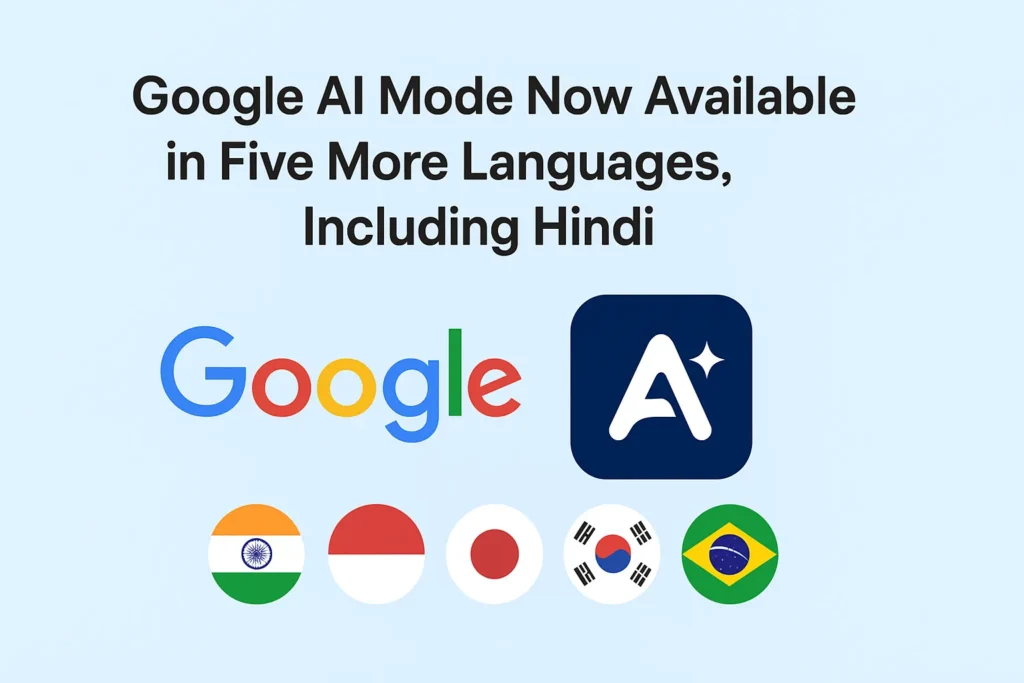
In a major step toward making search more inclusive and intelligent, Google AI Mode is now available in five more languages, including Hindi. Until now, Google’s experimental AI-powered search mode—often referred to as AI Mode—was limited to English-speaking users in select regions. With this update, users across the globe can now access AI-enhanced search results and conversational experiences in Hindi, Indonesian, Japanese, Korean, and Brazilian Portuguese.
This expansion marks a significant moment in Google’s broader vision of building a search ecosystem that is more accessible, localized, and conversational. India, for example, is one of the largest digital markets in the world, where Hindi is widely spoken. By bringing Hindi into AI Mode, Google isn’t just updating a tool—it’s recognizing the importance of regional languages in shaping the future of digital search and AI adoption.
The move comes at a time when AI-driven search tools are becoming a global standard, influencing how people interact with information online. For both everyday users and professionals in the digital and SEO industries, this rollout is more than a language update; it represents a shift toward a more global, AI-centric internet experience.
What’s New in AI Mode
So, what exactly has changed with this update? Let’s break down the highlights.
- Languages Added: Hindi, Indonesian, Japanese, Korean, and Brazilian Portuguese.
- Availability: Accessible globally, but with gradual regional rollouts, especially in countries where these languages are dominant.
- AI-Powered Responses: Users can now type or speak queries in their native language and receive AI-generated summaries, contextual answers, and follow-up prompts.
- Multimodal Capabilities: Just like in English, users can interact with AI Mode using text, voice, or images, making it easier to get contextual answers.
This is particularly impactful in India. Until recently, many Hindi-speaking users had to rely on English search queries to access the full power of Google Search. With AI Mode in Hindi, the search experience becomes more natural and culturally aligned. Imagine a student asking a complex academic question in Hindi or a traveler using image-based queries to identify landmarks—AI Mode is designed to respond intelligently in their preferred language.
In other regions, the rollout is equally significant. For example:
- In Brazil, Portuguese-speaking users can now explore AI search without language barriers.
- In Japan and Korea, where search culture already emphasizes localized apps, Google’s entry with AI Mode in native languages could transform user habits.
- In Indonesia, with its rapidly growing digital population, AI-driven search in the local language could be a game-changer for accessibility.
By localizing AI Mode, Google ensures that AI-powered search is not an English-only feature but a truly global innovation.
Global Rollout Context
Before this update, Google AI Mode was primarily limited to English-speaking audiences. It first launched in the United States via Search Labs and quickly expanded to over 180 countries and territories. However, the language barrier remained a significant limitation.
English may be the global lingua franca of technology, but it is far from being the only language people use online. In fact:
- Hindi is spoken by more than 600 million people worldwide.
- Portuguese is the sixth most spoken language globally, with Brazil leading its digital adoption.
- Japanese and Korean have long been associated with advanced tech markets.
- Indonesian, spoken by over 200 million people, represents one of the fastest-growing internet communities.
By expanding beyond English, Google is addressing a critical inclusivity gap. More importantly, it’s a strategic move to strengthen Google’s position in markets where local languages dominate digital culture.
This global rollout also aligns with Google’s mission: to organize the world’s information and make it universally accessible and useful. If AI Mode remained English-only, it would contradict that mission. By embracing more languages, Google takes a clear step toward democratizing AI-powered search worldwide.
Google’s Official Statement
Google officially announced the update through its product blog and press coverage, emphasizing the use of its advanced Gemini 2.5 AI model to power this multilingual expansion. According to Google, the AI Mode update is designed to:
- Provide localized answers that are contextually relevant to each language.
- Enhance comprehension of non-English queries, including idioms, slang, and cultural nuances.
- Deliver conversational follow-ups, so users can ask additional questions naturally in their own language.
In Google’s words, this expansion is not just a technical rollout but a cultural adaptation of AI search. For instance, Hindi users won’t simply get translated English answers—they’ll get answers that align with local context and cultural references.
Google also highlighted the significance of using a custom version of Gemini 2.5 for this rollout. This model has been trained to understand multilingual queries better and provide faster, more accurate, and culturally nuanced responses.
For businesses, educators, and content creators, this means AI Mode could open new opportunities to connect with audiences in their native languages, while still benefiting from Google’s powerful AI systems.
Read More: Google Blog – AI Mode Expands to More Languages
History of AI Mode Expansion
To fully appreciate the importance of this update, let’s look at how AI Mode has expanded so far:
- March 2025 – U.S. Launch (Search Labs): AI Mode first appeared in the U.S. through Google’s Search Labs, allowing select users to test AI-powered search.
- May 2025 – U.S. Wide Release: After a successful trial, Google rolled out AI Mode across the U.S. market.
- June 2025 – India Rollout: Recognizing India’s huge digital audience, Google expanded AI Mode access in English for Indian users.
- September 2025 – Multilingual Expansion: AI Mode officially became available in five more languages, with Hindi being the most significant addition for India’s growing online population.
This timeline shows Google’s step-by-step approach: starting with testing in one market, then gradually scaling globally, and now breaking language barriers. The rollout reflects Google’s long-term strategy—making AI search a default experience for billions of users, no matter what language they speak.
The history also highlights Google’s focus on local-first expansion. India, Brazil, Japan, Korea, and Indonesia are not random choices. These are strategic markets with high mobile penetration, massive internet adoption, and strong demand for localized digital services.
In essence, this update is a culmination of years of research and gradual expansion, proving Google’s commitment to building an AI-powered, language-inclusive search engine.
How AI Mode Works
To understand the impact of this update, it’s important to know how Google AI Mode functions behind the scenes. Unlike traditional search, where results are displayed as a list of links and snippets, AI Mode uses a conversational, AI-powered system that summarizes and organizes information dynamically.
1.1 The “Query Fan-Out” Process
Google’s AI Mode doesn’t just look at one or two web pages when answering a query. Instead, it uses a “query fan-out” approach:
- When a user enters a question, the system generates multiple interpretations of the query.
- These versions are then matched against a wide range of indexed sources.
- The AI evaluates the reliability, authority, and context of the content before presenting a consolidated response.
For example, if a user asks in Hindi: “भारत में सबसे अच्छे MBA कॉलेज कौन से हैं?” (Which are the best MBA colleges in India?), AI Mode won’t just translate and return English-based results. It will gather information from Hindi-language educational portals, university sites, and credible ranking sources, and then present a summarized yet comprehensive answer in Hindi.
1.2 Multimodal Capabilities
AI Mode supports text, voice, and image inputs, making it more versatile than traditional search.
- Text: Standard typed queries, whether in English or Hindi.
- Voice: A natural way for users in India and Indonesia, where many people prefer speaking over typing.
- Images: Uploading a photo (say, of a landmark or product) and asking the AI to identify it or provide contextual details.
Imagine a Japanese tourist in Delhi who clicks a photo of India Gate and uploads it to AI Mode. They could ask in Japanese: “この建物の歴史は何ですか?” (What is the history of this building?), and receive an AI-generated summary in Japanese.
1.3 Conversational Follow-Ups
One of the strongest features of AI Mode is its ability to maintain conversation-like continuity. Instead of starting a new query each time, users can ask follow-up questions.
Example:
- First Query (Hindi): “भारत में सबसे अच्छे MBA कॉलेज कौन से हैं?”
- Follow-Up: “इन कॉलेजों की फीस कितनी है?” (What are the fees of these colleges?)
- Next Follow-Up: “क्या इनमें ऑनलाइन MBA प्रोग्राम भी उपलब्ध हैं?” (Do these colleges also offer online MBA programs?)
The AI remembers the context, ensuring a smoother and more human-like interaction.
1.4 Custom Gemini 2.5 Integration
Behind the scenes, Google’s Gemini 2.5 AI model powers this multilingual rollout. Unlike earlier models, Gemini 2.5 is trained extensively on multilingual datasets and localized content, ensuring accuracy and cultural sensitivity.
This means when someone asks in Brazilian Portuguese about local recipes or in Korean about K-pop trends, AI Mode can provide culturally rich, context-aware responses, not just machine translations.
Implications for Users and SEO
The introduction of Google AI Mode in Hindi and other languages goes far beyond convenience. It has deep implications for everyday users, businesses, and the world of digital marketing.
1.1 Implications for Everyday Users
- Accessibility: Millions of users who previously struggled with English-only search can now use AI Mode in their native language.
- Personalized Learning: Students can ask academic questions in their mother tongue, making education more inclusive.
- E-Commerce Benefits: Shoppers can ask queries about products in local languages, improving online shopping experiences.
- Cultural Relevance: Answers are localized, meaning they include references familiar to the cultural background of the user.
1.2 Implications for Businesses
For businesses, especially in emerging markets, this update opens new doors.
- Local Market Reach: Companies can now optimize their content in regional languages like Hindi, Indonesian, or Portuguese to capture new audiences.
- Enhanced Engagement: Providing customer support or product FAQs in local languages will soon become the norm.
- Competitive Advantage: Brands that adapt early to multilingual SEO strategies will stand out in AI-driven search results.
Example: A small Indian startup selling eco-friendly bags can now rank in AI Mode by publishing content in Hindi, something that wasn’t possible in the English-only AI Mode.
1.3 Implications for SEO Professionals
SEO is undergoing a paradigm shift with AI Mode. Traditional keyword strategies won’t be enough. Instead, focus areas include:
- Conversational Queries: AI Mode thrives on natural language questions. SEO experts must optimize content for question-based search patterns.
- Semantic Search: Instead of stuffing keywords, content must be context-rich and semantically optimized.
- Multilingual Content: Brands must start creating localized content in multiple languages to stay visible in AI-generated summaries.
- E-E-A-T (Experience, Expertise, Authoritativeness, Trustworthiness): AI Mode heavily prioritizes authoritative content. Strong E-E-A-T signals will be critical.
In short, SEO professionals need to rethink their strategies for an era where search isn’t just about links—it’s about AI-powered conversations.
Looking Ahead
The rollout of AI Mode in five additional languages is just the beginning. Google has made it clear that this is part of a long-term vision to integrate AI into every aspect of search.
1.1 Future Language Expansion
Currently, AI Mode supports English + five new languages. But Google is expected to add more languages soon, including:
- Arabic, one of the world’s most widely spoken languages.
- Spanish, with over 500 million speakers globally.
- African languages like Swahili, to address fast-growing internet regions.
The ultimate goal seems to be a truly multilingual AI search system, covering all major global languages.
1.2 AI-First Search Experience
Google is gradually moving toward making AI Mode the default search experience. While traditional search won’t disappear, AI summaries and conversational responses could become the primary interface.
This means the future of search may look less like “ten blue links” and more like dynamic, AI-generated knowledge panels, tailored to each user’s language and preferences.
1.3 Integration With Other Google Products
AI Mode could soon be integrated with other Google services, such as:
- Google Maps: Conversational queries in local languages for directions or recommendations.
- Google Lens: Deeper multimodal search with AI-powered context.
- Google Assistant: More natural, AI-driven conversations across devices.
1.4 Shaping the Digital Economy
By enabling billions of non-English speakers to access AI-driven search, Google is also shaping the digital economy of the future. Businesses, advertisers, educators, and governments will all need to adapt to this AI-centric, multilingual internet.
Conclusion
The update—Google AI Mode Now Available in Five More Languages, Including Hindi—is more than a product rollout. It’s a milestone in the evolution of search. By breaking the English-language barrier, Google has taken a decisive step toward creating a global, inclusive, and conversational search experience.
For users, this means greater accessibility and the ability to interact with AI in the language they’re most comfortable with. For businesses and SEO professionals, it means an urgent need to adapt content strategies to a multilingual, AI-first world.
Looking ahead, it’s clear that Google is not stopping at five languages. This expansion is just the beginning of a revolution in search technology—a revolution where AI is not only smart but also culturally and linguistically inclusive.
In this new era, search isn’t just about finding information—it’s about understanding, conversing, and connecting with the world in your own language.