


In today’s connected world, digital marketing is no longer an option — it’s a necessity. Every business, from startups to global enterprises, relies on digital platforms to reach customers, build brand visibility, and drive sales. But what exactly is digital marketing, and why is it so crucial in 2025?
This guide breaks down what digital marketing is, how it works, its major types, benefits, and the steps to build a winning strategy. Whether you’re a business owner, marketing professional, or entrepreneur, you’ll learn the essentials of creating a strong digital presence, understanding your audience, and maximizing results.
What Is Digital Marketing?
At its core, digital marketing refers to all promotional efforts that use the internet or electronic devices to connect with potential customers. It includes a wide range of activities — from running social media campaigns and creating SEO-optimized content to sending emails and running Google ads.
In simple terms, digital marketing is any marketing that takes place online.
Digital Marketing vs. Online Marketing
While the terms are often used interchangeably, there’s a subtle difference:
- Digital marketing includes all digital channels — even those not connected to the internet (like SMS marketing or digital billboards).
- Online marketing, however, focuses strictly on internet-based activities such as websites, blogs, search engines, and social platforms.
The Three Media Types in Digital Marketing
- Owned Media: Channels you control (your website, blog, email list).
- Earned Media: Publicity gained through organic mentions, shares, or reviews.
- Paid Media: Paid promotions such as PPC ads, display banners, and sponsored posts.
Understanding these core elements helps you build a balanced digital marketing mix that drives visibility and credibility simultaneously.
The Evolution of Digital Marketing
Digital marketing has come a long way from the first banner ad in 1994. The evolution has been driven by technology, consumer behavior, and data analytics.
A Brief Timeline
- 1990s: The birth of search engines and email marketing.
- 2000s: Rise of Google Ads, SEO, and early social networks like MySpace and Facebook.
- 2010s: Explosion of mobile marketing, influencer culture, and video content.
- 2020s: AI-driven marketing, automation tools, and data privacy compliance dominate.
How Consumer Behavior Changed
Today’s consumers are more informed and empowered than ever before. They research products online, compare competitors, and rely heavily on social proof (reviews and testimonials). Traditional one-way marketing messages have been replaced by two-way conversations, where customer experience and engagement define success.
Digital marketing adapts to this behavior — allowing businesses to meet customers where they are, deliver personalized content, and measure results in real time.
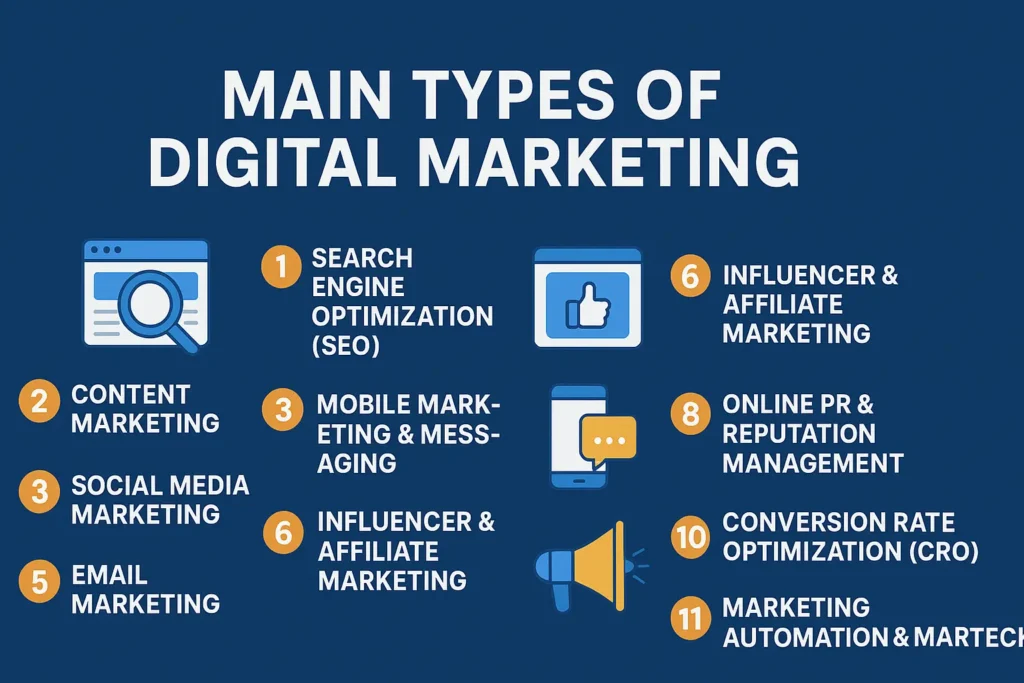
Main Types of Digital Marketing (Channels & Tactics)
Digital marketing covers a wide range of disciplines. Here are the most essential types every marketer should know:

1. Search Engine Optimization (SEO)
SEO is the foundation of any digital marketing strategy. It’s the process of optimizing your website and content so that search engines like Google rank your pages higher for relevant queries.
Key elements include:
- On-page SEO: Optimizing titles, meta descriptions, and keywords.
- Off-page SEO: Building backlinks and brand mentions.
- Technical SEO: Improving site speed, mobile-friendliness, and indexing.
Good SEO ensures your brand appears when potential customers search for solutions like yours — making it a cost-effective long-term strategy.
2. Content Marketing
Content marketing revolves around creating valuable, informative, and engaging content that attracts and retains your audience.
Examples include:
- Blog posts, infographics, eBooks, whitepapers, and videos.
- Storytelling that connects with your audience emotionally.
- Optimizing every piece for SEO and conversions.
A well-executed content marketing strategy establishes authority, builds trust, and drives consistent traffic.
3. Social Media Marketing
Social media is where conversations happen. Platforms like Facebook, Instagram, LinkedIn, X (Twitter), and TikTok help brands engage audiences directly.
Organic social focuses on community building and brand awareness, while paid social uses targeted ads to reach specific demographics.
Key strategies include:
- Posting consistently.
- Using video and story formats.
- Engaging with followers and responding to messages quickly.
- Tracking insights to adjust content performance.
4. Pay-Per-Click Advertising (PPC)
PPC ads allow you to place ads on search engines or websites and pay only when someone clicks.
Platforms like Google Ads, Meta Ads, and LinkedIn Ads are most popular.
Benefits include:
- Fast results compared to organic SEO.
- Complete budget control.
- Precise audience targeting by location, device, or interest.
Effective PPC combines keyword research, compelling ad copy, and optimized landing pages to maximize ROI.
5. Email Marketing
Despite being one of the oldest forms of digital marketing, email remains one of the most effective.
Key uses:
- Sending newsletters and product updates.
- Lead nurturing with automated sequences.
- Personalized offers to increase retention and sales.
Email campaigns should focus on segmentation, strong subject lines, and mobile-friendly design.
6. Influencer & Affiliate Marketing
Influencer marketing involves partnering with individuals who have large online followings. Affiliate marketing, on the other hand, rewards external partners for generating leads or sales.
Together, these methods help expand reach, boost credibility, and attract new audiences organically.
7. Mobile Marketing & Messaging (SMS / WhatsApp)
Mobile marketing focuses on engaging users through their smartphones. This includes SMS campaigns, app-based ads, and WhatsApp marketing.
With mobile usage surpassing desktop, brands that optimize campaigns for mobile devices gain a competitive edge.
8. Online PR & Reputation Management
Your online reputation directly impacts conversions. Digital PR involves getting mentions in online publications, managing customer reviews, and handling feedback professionally.
Proactive PR helps build brand authority and trust — two pillars of successful digital marketing.
9. Conversion Rate Optimization (CRO)
CRO is about turning website visitors into customers. It involves analyzing user behavior, A/B testing landing pages, and improving design or messaging.
A small improvement in conversion rate can dramatically boost revenue — making CRO one of the highest-ROI digital marketing activities.
10. Marketing Automation & Martech
Modern digital marketing relies on automation tools and integrated platforms.
Examples: HubSpot, Mailchimp, ActiveCampaign, or Adobe Experience Cloud.
Automation saves time, ensures consistency, and delivers personalized experiences at scale.
Key Benefits of Digital Marketing
Digital marketing’s biggest advantage lies in its measurability and reach. Unlike traditional methods, you can track every impression, click, and conversion.
Major Benefits:
- Global Reach: Reach audiences worldwide through online channels.
- Cost Efficiency: Lower cost per lead compared to offline marketing.
- Precise Targeting: Segment audiences by interests, demographics, or behavior.
- Data-Driven Decisions: Analyze performance instantly with analytics.
- Personalization: Deliver custom messages that increase engagement.
- Brand Credibility: Build authority through consistent online presence.
- Flexibility: Adjust campaigns anytime based on data insights.
These benefits make digital marketing the most powerful tool for sustainable business growth in 2025 and beyond.
How to Create a Digital Marketing Strategy (Step-by-Step Framework)
To get results, you need a solid, structured plan. Follow these steps to build a digital marketing strategy that aligns with your goals:
Step 1: Define Clear Business Goals
Set SMART goals — Specific, Measurable, Achievable, Relevant, Time-bound.
Example: “Increase website leads by 30% in the next 90 days.”
Step 2: Identify Your Target Audience
Research demographics, interests, and pain points. Create buyer personas to personalize communication.
Step 3: Audit Existing Assets
Evaluate your website, social media presence, content, and analytics setup. Identify what’s working and what needs improvement.
Step 4: Choose the Right Channels
Select digital platforms that align with your goals and audience — SEO, social, PPC, or email.
Step 5: Create Compelling Content
Develop a content calendar with blog posts, videos, social updates, and downloadable resources.
Step 6: Set Up Tracking & Analytics
Use tools like Google Analytics, Search Console, and Meta Insights to monitor campaign performance.
Step 7: Launch, Test & Optimize
Start small, analyze results, and refine. Testing headlines, visuals, and CTAs helps identify what works best.
Step 8: Measure & Scale
Track KPIs regularly. Scale high-performing campaigns and improve low-performing ones.
A well-planned strategy ensures every marketing dollar delivers measurable value.
Digital Marketing Metrics and KPIs
To understand whether your digital marketing efforts are successful, you must track performance through Key Performance Indicators (KPIs).
Core Metrics to Track
- Traffic Metrics: Sessions, page views, and bounce rate.
- Engagement Metrics: Average time on page, social shares, click-through rates.
- Lead Metrics: Conversion rate, cost per lead (CPL), and lead quality.
- Sales Metrics: Revenue, customer acquisition cost (CAC), and ROI.
- Retention Metrics: Repeat purchases, churn rate, and lifetime value (LTV).
Tracking these KPIs helps optimize campaigns and identify your most profitable marketing channels.
Top Tools and Platforms
The right tools streamline digital marketing and improve accuracy. Below are some essential platforms categorized by function:
Analytics & Tracking
- Google Analytics 4 – Website performance and audience insights.
- Google Search Console – Search visibility and SEO monitoring.
SEO Tools
- Keyword research and competitor tracking tools (e.g., SEMrush, Ahrefs, Moz).
Social Media Management
- Tools like Buffer, Hootsuite, or Later for scheduling and analytics.
Email & Automation
- Platforms such as Mailchimp, ActiveCampaign, or HubSpot for email sequences and customer segmentation.
Ad Management
- Google Ads, Meta Ads Manager, and LinkedIn Campaign Manager for paid campaigns.
CRM & Lead Management
- HubSpot, Zoho CRM, or Salesforce for managing leads, nurturing, and tracking sales pipelines.
Choosing the right toolset ensures you can automate repetitive tasks, measure success efficiently, and maintain a 360° view of your digital ecosystem.
Challenges and Risks in Digital Marketing
While digital marketing offers incredible potential, it’s not without challenges. The online landscape evolves daily — algorithms change, privacy laws tighten, and user expectations rise. To succeed long-term, marketers must understand and address these challenges strategically.
1. Constant Algorithm Changes
Search engines and social media platforms frequently update their algorithms. What worked yesterday might not work today.
Solution: Stay updated with trusted industry sources, diversify your traffic channels, and focus on creating genuine, value-driven content.
2. Data Privacy and Compliance
With GDPR, CCPA, and other privacy laws, businesses must collect and use customer data ethically.
Solution: Use transparent opt-ins, secure storage systems, and give users control over their information. Building trust enhances brand credibility.
3. Ad Fatigue and Content Overload
Consumers are exposed to thousands of ads daily. Overexposure leads to banner blindness or disengagement.
Solution: Focus on storytelling, personalization, and interactive content. Rotate creatives regularly and keep messaging fresh.
4. Rising Competition
Every niche online is saturated. Competing for visibility requires creativity and consistency.
Solution: Identify your unique selling proposition (USP), target niche segments, and maintain an authentic brand voice.
5. Attribution and Measuring ROI
Tracking which channel truly drives conversions can be complicated.
Solution: Use analytics tools and attribution models (first click, last click, multi-touch). Always define clear KPIs before launching campaigns.
6. Technology and Tool Overload
With hundreds of platforms available, marketers often suffer from “tool fatigue.”
Solution: Choose integrated tools that match your business needs and budget. Avoid redundancy — simplicity drives productivity.
Understanding these risks is crucial. The best digital marketers view challenges not as obstacles but as opportunities to adapt and innovate.
B2B vs. B2C Digital Marketing (and the Real Estate Example)
Digital marketing strategies vary widely depending on whether you’re targeting businesses (B2B) or consumers (B2C). Let’s explore the key differences — and see how these principles apply to real estate professionals as a practical example.
B2B (Business-to-Business) Digital Marketing
In B2B, the target audience is other businesses or professionals. The focus is on relationship building, expertise, and long-term value.
Key Characteristics:
- Longer sales cycle and multiple decision-makers.
- Content-focused strategies like whitepapers, webinars, and LinkedIn marketing.
- Emphasis on nurturing leads and demonstrating ROI.
- Channels: LinkedIn, email marketing, SEO, and account-based marketing (ABM).
B2C (Business-to-Consumer) Digital Marketing
B2C marketing targets individuals. Decisions are often emotional and instant.
Key Characteristics:
- Shorter buying cycles with impulse-driven behavior.
- Focus on visuals, emotional storytelling, and direct response ads.
- Channels: Social media, influencer marketing, and paid ads.
Example: Digital Marketing in Real Estate
Real estate sits beautifully between B2B and B2C. Realtors and agencies must appeal to both individual buyers and professional investors.
Here’s how digital marketing applies:
- SEO & Local Search: Optimize listings for “homes for sale near me.”
- Social Media: Use Instagram and Facebook to showcase properties.
- Content Marketing: Write blogs about “home buying tips” or “neighborhood guides.”
- Email Campaigns: Send property alerts and newsletters.
- Automation: Hire a real estate virtual assistant to manage inquiries, schedule tours, and follow up with leads.
This hybrid approach demonstrates how understanding your audience shapes your digital strategy.
Implementation Checklist (30/60/90-Day Plan)
A strategy is only as strong as its execution. This 90-day action plan helps you implement digital marketing step by step — from groundwork to optimization.
First 30 Days: Setup and Foundation
- Define Goals: Set SMART objectives for brand awareness, lead generation, or sales.
- Conduct Market Research: Identify audience needs, competitors, and keywords.
- Build Your Website or Optimize Existing One: Ensure mobile responsiveness, fast load times, and clear CTAs.
- Set Up Analytics Tools: Google Analytics 4, Search Console, and heat mapping tools.
- Create Initial Content: Blog posts, landing pages, or videos introducing your brand.
Days 31–60: Campaign Launch and Optimization
- Start SEO Implementation: Publish optimized content targeting high-intent keywords.
- Launch Paid Campaigns: Run small-budget PPC or social ads to test targeting and creatives.
- Create Email Sequences: Welcome emails and drip campaigns for new subscribers.
- Engage on Social Media: Post regularly, reply to comments, and join niche communities.
- A/B Testing: Experiment with ad copies, visuals, and landing page elements.
Days 61–90: Scale and Automate
- Evaluate Performance: Review analytics reports and identify top-performing channels.
- Refine Strategy: Shift budget to high-ROI platforms.
- Implement Automation: Use tools to automate email marketing, lead follow-ups, and social posting.
- Build Authority: Guest posting, influencer collaborations, and partnerships.
- Expand Campaigns: Scale content production and remarketing ads.
Following this checklist keeps your digital marketing journey organized and measurable.
Case Studies and Real-World Examples
Learning from successful digital marketing campaigns can inspire new ideas and tactics. Below are three condensed case studies demonstrating real-world impact.
Case Study 1: Local Café Boosts Sales via Social Media Ads
Goal: Increase local foot traffic.
Strategy: Created Instagram Reels highlighting daily specials and geo-targeted Facebook ads within a 5 km radius.
Result: 45% increase in in-store visits within 60 days.
Case Study 2: B2B SaaS Company Grows Leads Through SEO
Goal: Generate qualified leads organically.
Strategy: Published SEO-optimized blogs around industry pain points and implemented LinkedIn content strategy.
Result: 120% organic traffic growth and 65% more demo sign-ups in 3 months.
Case Study 3: Real Estate Agency Uses Virtual Assistants to Scale Digital Marketing
Goal: Increase qualified buyer leads and reduce manual workload.
Strategy: Hired a real estate virtual assistant to manage email campaigns, social media, and CRM updates.
Result: Lead response time dropped by 70%, and conversions improved by 35%.
These examples prove that digital marketing success depends not on company size, but on smart strategy, consistency, and the right use of technology.
Resources and Templates
To help you get started, here are some handy digital marketing resources and templates you can use immediately.
A. Content Calendar Template
Plan blogs, social media posts, and campaigns by week or month. Include columns for keywords, goals, and publishing dates.
B. SEO Checklist
- Keyword research complete
- Meta tags optimized
- Internal linking added
- Page speed tested
- Mobile usability verified
C. KPI Tracking Sheet
Track impressions, clicks, conversions, cost per lead (CPL), and ROI across channels.
D. 90-Day Marketing Plan Template
Break your digital marketing roadmap into weekly tasks with defined responsibilities.
E. Free Tools to Try
- Canva: Design visuals easily.
- Google Keyword Planner: Find relevant search terms.
- Grammarly: Polish written content.
- Buffer: Schedule social media posts.
- Mailchimp: Send and automate emails.
These resources simplify planning and execution — ensuring consistency across all campaigns.
Conclusion and Next Steps
Digital marketing is not just a buzzword; it’s the foundation of modern business success. It empowers brands to connect, communicate, and convert customers globally — all in real time.
Here’s a quick recap of what we covered:
- What digital marketing is and how it evolved.
- Major channels like SEO, content, social media, and PPC.
- Key benefits, challenges, and metrics.
- How to build a winning strategy step-by-step.
If you’re new, start small — focus on one or two channels, create valuable content, and measure results. Over time, expand your reach with advanced tools, automation, and data-driven strategies.
For businesses looking to save time and scale efficiently, consider delegating repetitive marketing tasks. Hiring a virtual marketing assistant or partnering with a professional agency can help you focus on strategy while experts handle execution.
The world of digital marketing is fast, dynamic, and rewarding — and the best time to start mastering it is now.
Appendix / Glossary of Common Terms
Here are some commonly used digital marketing terms to help you navigate the industry:
- CTR (Click-Through Rate): Percentage of users who click an ad or link.
- CPC (Cost Per Click): The amount paid for each ad click.
- CPL (Cost Per Lead): Average cost of acquiring one lead.
- ROI (Return on Investment): Profitability measure comparing revenue to cost.
- Conversion Rate: Percentage of visitors completing a desired action.
- Bounce Rate: Percentage of users who leave a webpage without taking action.
- Organic Traffic: Visitors who arrive through unpaid search results.
- Remarketing: Targeting users who previously interacted with your brand.
- Marketing Funnel: The customer journey from awareness to purchase.
- KPI (Key Performance Indicator): Metric used to evaluate marketing success.
Frequently Asked Questions (FAQs)
Digital marketing means promoting products or services using online and electronic platforms such as websites, social media, search engines, and email.
Absolutely. It’s one of the most cost-effective ways for small businesses to reach customers, build brand awareness, and compete with larger firms.
SEO and organic growth may take 3–6 months, while paid ads can show results within days. Consistency and optimization are key.
The future is AI-driven personalization, voice search optimization, short-form video content, and privacy-focused strategies.
While social media can generate awareness, a website adds credibility and acts as your central marketing hub.