


AI Overview Summary:
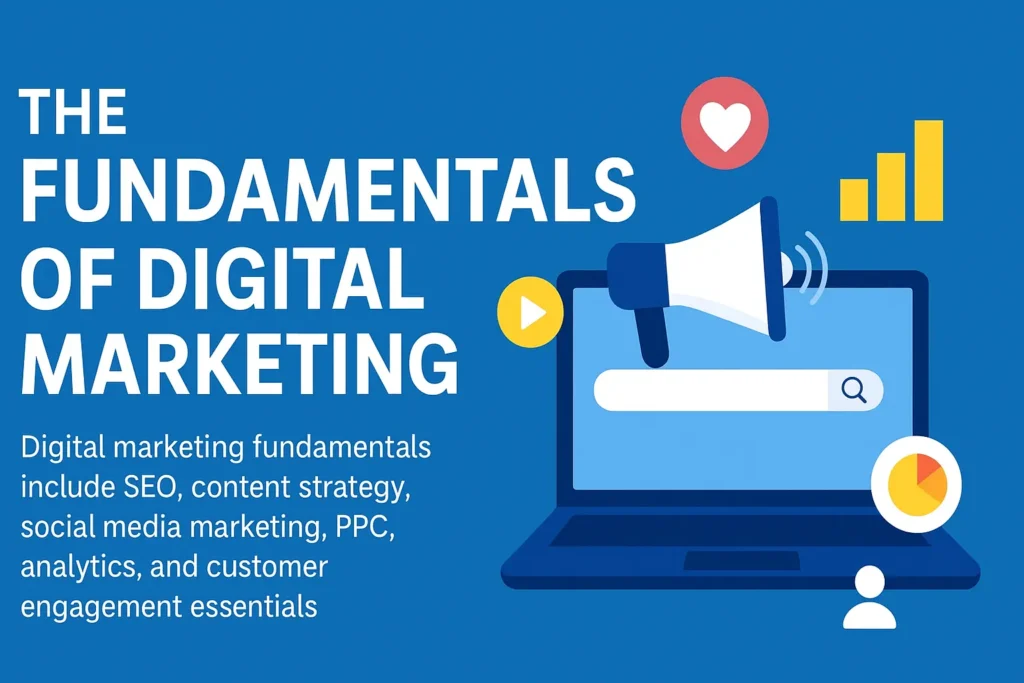
Digital marketing is the practice of promoting products and services using online channels. The fundamentals include SEO, content marketing, social media, email marketing, PPC, and analytics. These basics help businesses increase visibility, attract customers, and drive sales. Beginners can start with free courses, practical exercises, and essential tools like Google Analytics and AI-powered platforms. Strong fundamentals ensure long-term digital success.
Introduction to The Fundamentals of Digital Marketing
Digital marketing has become one of the most essential skills of the modern business world. Whether you are running a small business, building a personal brand, growing a startup, or starting a career in marketing—understanding The Fundamentals of Digital Marketing is your first and most important step.
Today’s customers live online. They search online, compare online, review online, and buy online. This shift in user behavior has transformed the way businesses attract, engage, and convert audiences. Digital marketing is not just an optional strategy anymore; it is a core growth driver.
Understanding the fundamentals helps you:
- Create strong online visibility
- Promote your products effectively
- Build brand trust
- Generate quality leads
- Convert visitors into loyal customers
In this blog, we will break down the essential elements of digital marketing in a simple, practical, and beginner-friendly way—so you can confidently start your digital journey.
What Is Digital Marketing? A Simple Overview
Digital marketing refers to the use of digital channels—such as websites, search engines, social media, emails, and online ads—to promote products, services, or brands.
Unlike traditional marketing, digital marketing is:
- Cost-effective
- Targeted
- Data-driven
- Measurable
- Fast and flexible
Businesses can reach millions of potential customers in real time through platforms like Google, YouTube, Instagram, Facebook, LinkedIn, and email.
Key areas included in digital marketing:
- Search Engine Optimization (SEO)
- Social Media Marketing
- Content Marketing
- Email Marketing
- Paid Advertising (Google Ads, Meta Ads)
- Affiliate and Influencer Marketing
- Analytics and reporting
In simple words:
Digital marketing helps businesses communicate with customers where they spend most of their time—online.
Also Read: What Is Digital Marketing?
Why Understanding Marketing Fundamentals Matters Today
The marketing world is evolving faster than ever. New platforms, algorithm updates, AI tools, and changing customer expectations have made the digital landscape more competitive. This is why strong marketing fundamentals are essential.
1. User Behavior Has Changed
People prefer online shopping, social media browsing, mobile usage, and voice search more than ever.
2. Algorithms Keep Updating
Google, Instagram, YouTube—all constantly update their rules. Fundamentals help you adapt quickly.
3. High Competition
Almost every business is online now. Strong fundamentals help you stand out.
4. AI Is Taking Over Repetitive Tasks
AI tools can generate content, run analytics, and automate campaigns, but they still need human strategy and creativity.
5. Customers Expect Personalization
Understanding customer journey, segmentation, and targeting helps build trust and long-lasting relationships.
Without strong fundamentals, even the most advanced tools or ads won’t perform.
With fundamentals, you can consistently win in any digital environment.
Core Components of Digital Marketing
Digital marketing is built on several core pillars. Understanding these essentials will help you create a complete, balanced strategy.
1.1 SEO (Search Engine Optimization)
SEO is the practice of improving your website’s ranking on search engines like Google. When done right, SEO brings free, long-term, and high-quality traffic.
Main parts of SEO:
- Keyword Research
- On-page SEO
- Technical SEO
- Link Building
- Content Optimization
- User Experience (UX)
SEO is a fundamental part of digital marketing because it increases visibility without spending money on ads.
1.2 Content Marketing
Content marketing focuses on creating valuable, informative, and engaging content that attracts and educates your audience. It includes:
- Blog posts
- Videos
- Infographics
- Podcasts
- Ebooks
- Case studies
Good content improves SEO, engages your audience, and establishes your brand as an authority.
1.3 Social Media Marketing
Social media platforms like Instagram, Facebook, LinkedIn, TikTok, and YouTube help businesses:
- Build brand awareness
- Engage with customers
- Share content
- Run ads
- Build communities
Social media is one of the fastest ways to reach a large audience.
1.4 Email Marketing
Email marketing is one of the highest ROI strategies in digital marketing. It helps nurture customers, offer updates, and build trust.
Types of email campaigns:
- Welcome emails
- Newsletters
- Promotional emails
- Automated email sequences
- Retargeting emails
1.5 PPC (Pay-Per-Click) Advertising
PPC ads appear on platforms like Google, Facebook, Instagram, and YouTube.
Benefits:
- Instant visibility
- High control over budget
- Targeted reach
- Scalable results
1.6 Affiliate & Influencer Marketing
This method uses creators or partners to promote your products. It helps brands reach new audiences quickly and build credibility.
How Digital Marketing Works (Step-by-Step Explained)
Digital marketing may look complex, but it works through a simple framework:
Step 1: Understand your audience
Identify your target customer’s interests, pain points, location, and behavior.
Step 2: Choose your digital channels
Search engines, social media, websites, email—select the ones relevant to your brand.
Step 3: Create valuable and relevant content
Write blogs, make videos, post social content, and create email campaigns.
Step 4: Drive traffic to your website or landing page
Using SEO, ads, social media posts, and influencers.
Step 5: Convert visitors into leads or customers
With offers, CTAs, forms, or e-commerce purchases.
Step 6: Retain customers
Use email, upsells, discounts, and community building.
Step 7: Analyze and optimize
Track results through analytics and improve performance.
Digital marketing is not a one-time action—it’s a continuous cycle of testing, learning, and improving.
Key Fundamentals of Digital Marketing Success
To become successful in digital marketing, you must master these foundational principles:
1. Audience Research
Knowing your customer is the first rule of marketing.
2. Customer Journey Mapping
Understand how customers move from awareness → interest → decision → purchase.
3. Branding & Positioning
Your brand message must be clear, unique, and consistent.
4. Mobile-First Approach
More than 70% users browse on mobile. Your website and content must be mobile-friendly.
5. Data Analytics & Tracking
Tools like Google Analytics and Meta Insights help monitor performance.
6. Personalization
Users engage more when content matches their interests and behavior.
These fundamentals ensure long-term success in any digital strategy.
Digital Marketing Strategies for Beginners
If you’re new to digital marketing, start with simple but effective strategies:
- Learn basics of SEO
- Create valuable content
- Optimize your website
- Use social media consistently
- Build an email list
- Run small-budget ads
- Track performance weekly
- Experiment with AI tools
Beginners grow faster when they focus on clarity, consistency, and learning the fundamentals.
Importance of SEO in Digital Marketing
SEO is one of the most important fundamentals of digital marketing because:
- It brings organic traffic
- It reduces advertising costs
- It builds long-term brand authority
- It improves user experience
- It helps your website rank for important keywords
SEO makes sure that when people search on Google, your business appears on top. Without SEO, your content, website, or business will struggle to be seen.
Role of Content in Digital Marketing Growth
Content is the heart of digital marketing. No matter how advanced tools or algorithms become, content remains the most important factor for building trust, educating audiences, and driving conversions.
Good content helps:
- Improve search engine visibility
- Answer user questions directly
- Build brand authority
- Engage audiences on social media
- Support email and ad campaigns
- Convert leads into paying customers
Types of high-performing content include:
- Blog articles
- Short-form videos (Reels, Shorts, TikTok)
- Long-form YouTube videos
- Social media posts
- Guides and ebooks
- Case studies
- Infographics
- Webinars and live sessions
The rule is simple:
Consistent, valuable, and user-focused content leads to long-term digital growth.
Social Media & Community Building Fundamentals
Social media has become a critical part of digital marketing because it creates a direct connection between brands and customers. Platforms like Instagram, Facebook, LinkedIn, YouTube, and TikTok allow businesses to share content, run ads, communicate, and build communities.
Key fundamentals of social media marketing:
- Post consistently
- Share valuable and relatable content
- Use high-quality visuals
- Engage with comments and messages
- Use relevant hashtags
- Collaborate with influencers
- Track insights regularly
Strong community building leads to:
- Better engagement
- Higher brand loyalty
- Increased organic reach
- Word-of-mouth promotion
A brand with a community grows faster than a brand with just followers.
Using AI Tools in Digital Marketing (Modern Approach)
Artificial Intelligence has completely reshaped how digital marketing works. Today’s marketers use AI to speed up tasks, improve campaigns, and make smarter decisions.
How AI supports digital marketing:
- Content generation and optimization
- Predictive analytics
- Chatbots and automated support
- Personalized recommendations
- Smart ad optimization
- Real-time insights
- SEO analysis and keyword research
Some popular AI tools include:
- ChatGPT
- Jasper
- SurferSEO
- Google Gemini
- Notion AI
- Canva AI
- HubSpot AI
AI does not replace human marketers—but it enhances productivity, creativity, and performance when used correctly.
Future of Digital Marketing: Trends You Must Know
The digital landscape is changing rapidly, and the future of marketing will be shaped by several major trends. To stay ahead, businesses must understand and adopt these trends early.
Top upcoming trends:
- AI-Powered Content & Automation
- Voice Search Optimization (VSO)
- Short-Form Video Domination
- Hyper-Personalization
- Influencer Collaborations
- AR/VR Shopping Experiences
- Zero-Click Search Optimization
- First-Party Data Collection
- Privacy-Focused Marketing
Brands that adapt quickly to these trends will stay competitive in the digital-first economy.
Fundamentals of Digital Marketing Course Overview
A Fundamentals of Digital Marketing Course helps beginners develop strong foundational knowledge and hands-on skills. These courses usually include:
- SEO basics
- Content marketing
- Social media management
- Email marketing
- Google Ads and Meta Ads
- Website optimization
- Branding principles
- Analytics and reporting
- Introduction to AI tools
Good courses offer:
- Certifications
- Practical assignments
- Live projects
- Career guidance
They help students, job seekers, and entrepreneurs start their journey with confidence.
How to Start Learning Digital Marketing (Beginner Guide)
If you’re new to digital marketing, follow these steps to learn quickly and effectively:
Step 1: Understand the fundamentals
Start with SEO, content, social media, email marketing, and PPC.
Step 2: Watch tutorials and take online courses
YouTube, Coursera, Google Garage, HubSpot Academy.
Step 3: Practice consistently
Create a blog, Instagram page, or YouTube channel.
Step 4: Use free tools
Google Analytics, Search Console, Canva, Mailchimp, AI tools.
Step 5: Build a portfolio
Showcase your projects, ads, content, and website optimization work.
Step 6: Stay updated
Follow marketing blogs, join communities, and track new trends.
Consistency is the key—digital marketing grows with experiments, mistakes, and continuous learning.
Common Mistakes to Avoid in Digital Marketing
Beginners often make mistakes that slow their progress. Avoid these common errors:
❌ Ignoring SEO
Without SEO, your website cannot rank organically.
❌ Posting content without strategy
Publishing random content never works.
❌ Not understanding audience needs
Marketing becomes ineffective without knowing the customer.
❌ Overdependence on AI
AI helps, but your creativity and strategy matter more.
❌ No analytics tracking
If you don’t measure results, you cannot grow.
❌ Expecting fast results
Digital marketing takes consistency and patience.
Avoiding these mistakes will help you grow faster and achieve better results.
Conclusion:
Understanding The Fundamentals of Digital Marketing is the foundation of every successful digital journey. Whether you are a beginner or an experienced marketer, mastering the basics—SEO, content, social media, email, analytics, and AI integration—will help you build strong, scalable, and future-proof marketing strategies.
Digital marketing is not just about tools or trends.
It is about understanding people, creating value, solving problems, and building meaningful connections.
With strong fundamentals, you can confidently create campaigns, attract the right audience, and grow any business in today’s digital world.
✅FAQs For Fundamentals of Digital Marketing
The fundamentals of digital marketing include SEO, content marketing, social media marketing, email marketing, PPC advertising, analytics, and understanding customer behavior.
They help businesses reach their audience, improve online visibility, build trust, and drive consistent long-term growth across digital platforms.
Beginners can start with free online courses, YouTube tutorials, blogs, and hands-on practice through SEO, creating content, and managing social media profiles.
Yes. Digital marketing is one of the fastest-growing careers with high demand, flexible job options, and strong salary potential due to global digital transformation.
Common tools include Google Analytics, Search Console, Canva, ChatGPT, SEMrush, HubSpot, Mailchimp, Meta Ads Manager, and Ahrefs.
Most learners understand the basics within 2–4 months with consistent study and practice.
Digital marketing uses online channels, data, and automation, while traditional marketing uses offline media like TV, print, and billboards.
SEO and content marketing are the strongest long-term strategies, while social media and PPC deliver faster results.